
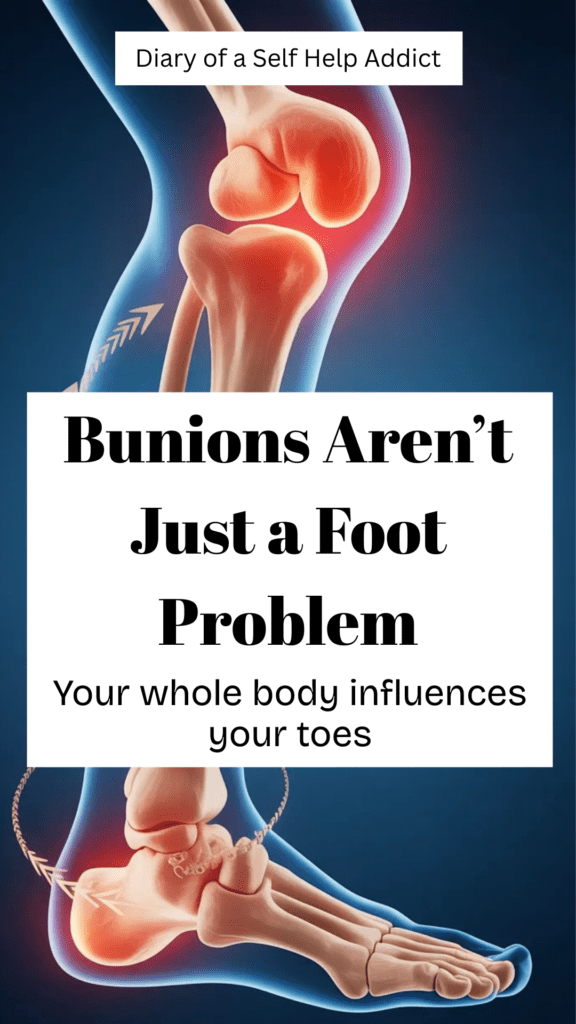
Why Treating Bunions Only at the Foot Often Falls Short
Most people are told bunions are genetic, inevitable, and purely a cosmetic or surgical issue.
But after years of working as a nurse and Pilates teacher, I’ve seen something very different:
Bunions are often a whole-body problem that shows up in the foot.
The foot is the foundation of movement. When force travels inefficiently through the hips, pelvis, and knees, that stress has to go somewhere. Very often, it ends up in the big toe joint.
This article is about understanding bunions through the lens of biomechanics, movement, and adaptation, and what you can do to improve function from the ground up.
What Is a Bunion, Anatomically?
A bunion (hallux valgus) is a structural change at the base of the big toe where:
- The first metatarsal drifts inward
- The big toe joint angles outward
- The joint becomes irritated and enlarged
This isn’t just a bump. It’s a shift in how forces travel through the foot.
The big toe plays a critical role in:
- Push-off during walking
- Balance and stability
- Shock absorption
When that joint loses alignment and mobility, the entire gait pattern changes.
And gait doesn’t stop at the foot—it influences the knees, hips, pelvis, and spine.
The Foot–Knee–Hip–Pelvis Chain
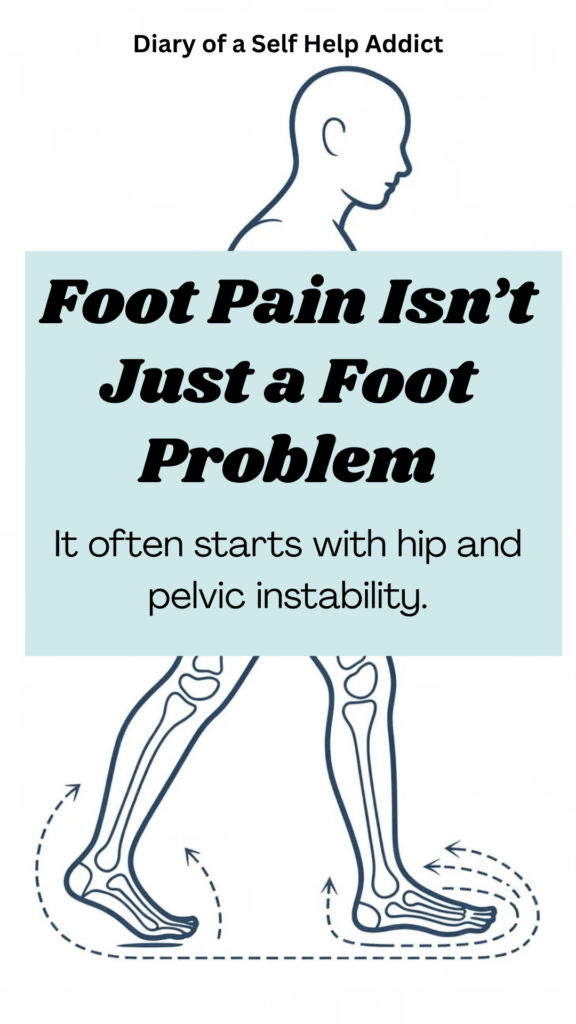
The body works as an integrated system. When one link in the chain changes, the others adapt. In my work with clients, I often get an early clue about pelvic and hip stability just by looking at someone’s feet. When bunions are present, it frequently signals that something higher up in the chain—especially the hips and pelvis—is not stabilizing efficiently. The feet are often where the compensation becomes visible.
How Hip Instability Affects the Foot
Weak or poorly coordinated hip stabilizers can allow the femur to rotate inward. This often leads to:
- Knee valgus (knees drifting inward)
- Altered weight distribution through the foot
- Increased pressure on the big toe joint
Over time, repeated stress encourages structural adaptation.
The foot is often blamed for a problem that started higher up.
How the Foot Feeds Back Up the Chain
Once a bunion develops and toe mobility decreases:
- Push-off becomes inefficient
- Gait shortens and stiffens
- Pelvic mechanics change
- Hip and knee stability are challenged
This feedback loop can contribute to discomfort far beyond the foot.
Bunions and Arthritis Risk
When joint alignment changes, cartilage experiences uneven loading.
Over time, this can increase irritation and contribute to arthritic changes—not only in the big toe, but also in the knees and hips.
Improving foot mechanics is not just about appearance. It’s about protecting the entire movement system.
The Role of Toe Mobility
Healthy feet require mobile toes.
In modern footwear, toes are often compressed, immobilized, and underused. This reduces the intrinsic foot muscles’ ability to stabilize the arch and support the big toe joint.
Daily toe mobility and strengthening exercises can:
- Improve joint spacing
- Restore muscle activation
- Enhance balance
- Support healthier gait patterns
I’ve worked with clients who have committed to consistent toe mobility work and seen visible improvements in toe alignment and function. While results vary from person to person, the foot is remarkably adaptable when given the right stimulus.
Exercises to Support Bunions and Whole-Body Alignment
The goal is not to force the toe straight. It’s to restore function, mobility, and coordination throughout the chain.
1. Gentle Toe Spreading and Stretching
Use your hands to gently separate and mobilize the toes. Take your time and make these stretches very intentional and stretchy—especially with the big toe. Gently pull the big toe in multiple directions (up, down, and slightly side to side) and hold each stretch for a moment while breathing. The goal is to restore elasticity and space in the joint, not to rush through the movement.
2. Big Toe Flexion and Extension
Practice lifting the big toe independently, then pressing it gently into the floor to activate stabilizing muscles.
3. Short Foot Exercise
Lightly draw the ball of the foot toward the heel without curling the toes to engage intrinsic foot muscles.
Check out this Premium Cork 4-in-1 Foot & Ankle Strengthener Kit, Balance Trainer on Amazon
4. Ankle Mobility Circles
Slow ankle circles improve fluid exchange and coordination between the foot and lower leg.
5. Deep Glute Stability Work
Targeted deep glute strengthening supports alignment upstream and reduces excess stress traveling into the foot. Exercises such as bridges, side-lying leg work, clamshell variations, and controlled standing balance exercises help activate the deep hip stabilizers that guide knee and foot mechanics.
Related Video: Fix Low Back, Hip, & Knee Pain with this 18-Minute Pilates Mat Routine
6. Gait Awareness
Walk slowly and intentionally, focusing on smooth heel-to-toe transfer and relaxed toe spread.
Consistency matters more than intensity. Small daily inputs create lasting change.
Why Movement Quality Matters More Than Orthotics Alone
Orthotics can sometimes provide short-term relief by redistributing pressure. But they don’t teach the foot or hips how to function differently.
Without restoring mobility and strength, the underlying pattern often remains.
Movement education gives the body options—and options reduce stress.
Kelly’s Thoughts: The Body Adapts When You Give It Better Input
Bunions are not a sign that your feet are broken. They are a sign that your body has been adapting to mechanical stress.
When you improve:
- Foot mobility
- Hip stability
- Gait mechanics
- Joint nourishment through movement
You change the environment in which your joints live.
And joints respond to their environment.
The foot is not separate from the rest of you. It is part of a beautifully coordinated system designed to adapt, learn, and improve.
Gentle Disclaimer
This article is for educational purposes only and reflects clinical experience and movement education. It is not intended to diagnose or replace individualized medical care.
If you have severe deformity, prior foot or joint surgery, or significant pain, consult a qualified healthcare professional before beginning new exercises.
Move gently. Progress gradually. Listen to your body.
As an Amazon Associate, I may earn a small commission on purchases from certain links at no extra cost to you. Thank you for supporting my small business!
Pin it for later
Leave a Reply