
Educational, relatable, and written for us non-science-brain folks.
Why I Wanted to Learn About KPV
If you’re anything like me, you’ve probably gone down a few (…okay, maybe many) rabbit holes when it comes to health and wellness. I love learning about tools that help the body heal itself — especially the ones that fly under the radar.
Recently, KPV kept popping up in my searches. At first, the name sounded like something you’d buy at a hardware store… not something that could help inflammation or gut health. But the more I read, the more I realized:
KPV is one of the simplest peptides, yet it may offer significant benefits.
And best of all?
Understanding it doesn’t require a medical degree. After all my digging, here’s the “explain it to a 5th grader, but still accurate and adult-useful” version.
Think of it like this:
👉 If your body is a giant city…
👉 KPV is like a tiny maintenance worker who goes around calming down fires, fixing broken fences, and helping neighborhoods get along again.
That’s basically its claim to fame.
This blog is me walking you through what I’ve learned about KPV in simple, clear language — no medical degree required — as I decide whether it deserves a spot in my personal wellness toolbox.
What Even Is KPV?
Let’s start super simple:
👉 A peptide is just a tiny chain of amino acids.
Amino acids are the building blocks your body uses to make things like muscles, skin, hormones, and more.
Now here’s the cool part about KPV:
KPV is made of ONLY THREE amino acids.
It’s what scientists call a “tripeptide.”
Its name literally comes from the first letter of each amino acid:
- K = Lysine
- P = Proline
- V = Valine
So K-P-V … KPV!
That’s it.
Simple. Tiny. Not scary.
Even though it’s tiny, studies suggest it may have significant effects — especially on inflammation and healing.
A Quick History Lesson (Without the Boring Parts)
KPV didn’t just show up on TikTok or wellness blogs yesterday.
Scientists discovered it years ago as part of a larger hormone called alpha-MSH. This hormone plays a major role in regulating inflammation throughout the body.
Researchers noticed something interesting:
👉 When they separated out just the little “K-P-V” part, that tiny piece still helped calm down inflammatory responses.
That’s when they realized KPV itself was doing a lot of the heavy lifting.
Since then, it’s been studied for things like:
- Gut inflammation
- Skin irritation
- Immune regulation
- Healing from flare-ups of inflammatory conditions
Because KPV is so small, your body usually tolerates it well, and it has a good “bioavailability” (meaning it’s easy to use and absorb).
What Does KPV Do? (The Simple Version)
Here’s the easiest way to understand it:
Imagine your immune system is like a smoke alarm.
It’s supposed to go off when there’s real danger — like germs or injuries.
However, the alarm sometimes goes off when it shouldn’t. This creates inflammation, which is like having the whole fire department show up for burnt toast.
KPV helps calm things down when your body gets too irritated and inflamed.
Kind of like:
- When your skin gets red and angry → KPV may help it chill out.
- When your gut becomes inflamed, KPV may help soothe the irritation.
- When your immune system is overreacting → KPV may help it stop “freaking out.”
Think of KPV like the peacekeeper in your body.
It doesn’t shut your immune system OFF — it just tells it,
“Whoa, buddy… that’s enough. Let’s not set the whole house on fire.”
What People Are Hoping KPV Can Help With
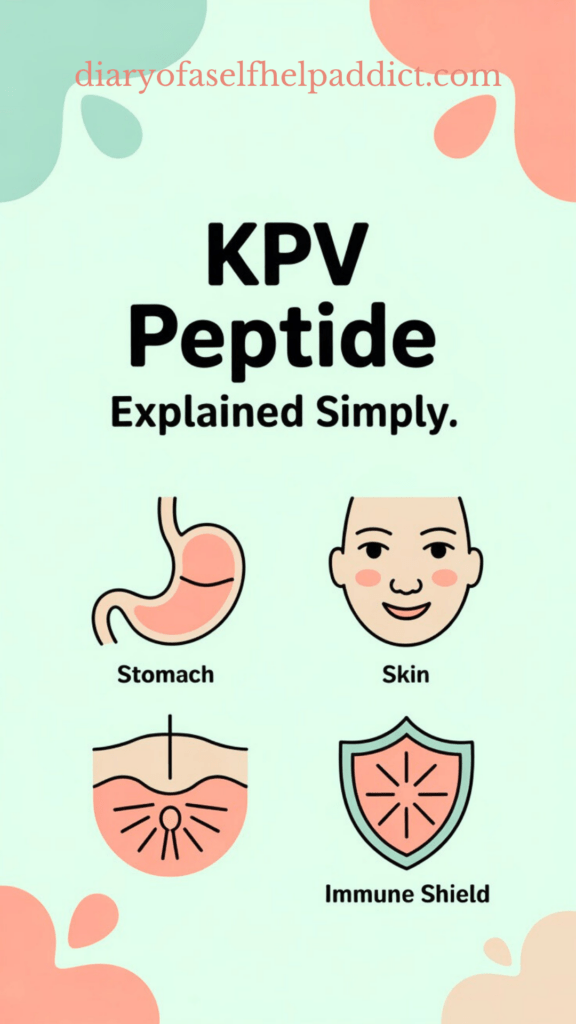
Even though research is still very early (mostly animal studies), people are exploring KPV for:
✨ 1. Gut Issues & Digestive Inflammation
People use KPV for:
- Bloating
- Irritated stomach
- Food-triggered inflammation
- IBS-type discomfort
- Gut lining repair
- After antibiotics
- When they eat something they shouldn’t have
KPV helps calm the gut without shutting down digestion.
✨ 2. Skin Problems
Because KPV reduces surface inflammation, people use it for:
- Acne
- Rosacea
- Redness
- Eczema flare-ups
- Wound healing
- Post-procedure irritation
Topical KPV creams are extremely popular in the skincare world.
✨ 3. Immune System Support
KPV doesn’t “boost” immunity. It balances it.
That means:
- If your immune system is overreacting → it calms it
- If you feel run down → it supports recovery
- If you’re about to get sick → it helps the body chill inflammation so your immune system can fight effectively
✨ 4. Inflammation From Workouts or Injury
People use KPV to soothe:
- Post-exercise inflammation
- Overuse injuries
- Tendon irritation
- Joint swelling
Does this replace BPC-157 or TB-500?
Not exactly — but it complements them beautifully.

When I Personally Would Use KPV
If I were keeping KPV in my peptide cabinet, here’s exactly when I’d reach for it:
✔ When I feel a cold or sinus infection coming on
The nasal spray version is amazing for calming sinus inflammation.
✔ After eating something that upsets my gut
I’d take an oral capsule to reduce bloating and irritation.
✔ During an IBS flare, food-triggered flare, or “my stomach hates me today” moment
A gentle way to calm the gut without suppressing digestion.
✔ After a tough workout when my joints or tendons feel inflamed
Not for muscle soreness — but for that irritated, inflamed feeling.
✔ When my skin is red, angry, or breaking out
Topical KPV is one of the “best kept secrets” in skincare.
✔ When my immune system feels “off”
You know the feeling — run-down but not fully sick.
✔ Whenever I want a low-risk, gentle anti-inflammatory option
Unlike some peptides, KPV is extremely small, natural, and very well tolerated.
How Do People Take It?
Typical dosing:
- Often 100–500 mcg in the am, 5 days on/2 days off for 4 weeks.
- Can be administered orally, nasally, as a suppository, or an injectable depending on protocol.
Who should avoid:
It’s generally well-tolerated and there are very few contraindications. (see below)
What Other Peptides Pair Well With KPV?
If KPV is the “calmer,” these are the “builders”:
🧩 BPC-157
Most common pairing.
Think of KPV as calming inflammation; BPC-157 helps repair tissue.
🧩 TB-500
Another recovery peptide that some people stack with KPV because it repairs and rebuilds damaged tissue.
🧩 Gut-healing nutrients
Not peptides, but often used together:
- Glutamine
- Collagen
- Probiotics
- Aloe
- Bone broth
Healing = two steps:
- Calm the fire
- Rebuild the damage
KPV is the “calm the fire” part.
Who Might Benefit?
If someone might be interested in KPV, it would typically be people who struggle with:
- Constant gut irritation
- Autoimmune-driven inflammation
- Skin flare-ups
- Redness, dermatitis, breakouts
- Slow recovery from stress or workouts
- Chronic inflammation where nothing else helps
Who Should Be Cautious?
KPV seems to be generally well-tolerated with a great safety profile, but since we lack big human studies, people who should definitely avoid it (without medical supervision) include:
- Pregnant or breastfeeding women
- People on immunosuppressant drugs
- People with unknown autoimmune conditions
- Anyone with allergies to peptides
- Kids (this is NOT a child-safe peptide)
What We Still Don’t Know
This is where I’m VERY realistic.
We still don’t know:
- The perfect dose
- The long-term effects
- Whether it works the same in humans as in animals
- How it interacts with medications
- Whether it’s safe for months or years
- Best way to take it
- How much actually gets absorbed
This is why KPV should be treated like an interesting tool, not a miracle cure.
Is KPV Worth Keeping in Your Wellness Toolbox?
In my opinion? YES, 100%!!
If you’re someone who battles inflammation, whether it’s in the gut, skin, or immune system, KPV seems like one of the gentlest and simplest peptides to explore.
I love that:
- It’s tiny (only three amino acids!)
- It’s known to be well-tolerated.
- It supports the body without overpowering it.
- It has research backing it.
- It works for multiple areas of the body.
To me, it feels like one of those “quiet heroes” in the wellness world.
Not flashy. Not hyped.
Just… steady, supportive, and simple.
Sometimes the smallest things really do make the biggest difference.
But I’m also cautious because:
- We need more real human studies.
- It’s still a research peptide.
- Purity varies from source to source.
- Dosing is basically guesswork.
So for now, I see KPV as one worth watching, learning about, and possibly exploring carefully with a knowledgeable provider.
Comment below if you’ve tried KPV and let me know how you liked it!
Where I Source Most of My Peptides
I’m often asked where I personally purchase peptides for my own research and wellness toolkit. Most of mine come from AMC Essentials.
👉 https://amc-essentials.com/ref/kelly.letalien/
I want to be fully transparent:
I’m not an affiliate, but I do receive a product discount when a new customer makes a purchase through my link. As a thank-you, you receive 10% off your order when you use it.
I share this simply because I’ve had a good experience with their sourcing, testing standards, and customer service — not because you have to buy from them. Always do your own research and choose what feels right for you. Make sure to always check certificates of authenticity (COA’s).
Medical Disclaimer
This blog is for educational purposes only and is not medical advice. Peptides should be used under the supervision of a qualified healthcare provider. Always consult your physician before beginning any new treatment, supplement, or protocol. For the full privacy policy & disclosure, click HERE.
Pin it for later
Leave a Reply