
Words are never just words.
They are vibrations, full of energy. They are instructions we give to our bodies, our minds, and even to the world around us. Whether spoken out loud, whispered under our breath, or repeated silently in our thoughts, words carry weight. They shape how we feel, how we heal, how we move, and how we experience life.
Most of us underestimate the power of language because we use words so casually. We say things like “This is killing me,” “I’m such an idiot,” “I’ll never get better,” or “That person drives me crazy” without realizing that our nervous system, subconscious mind, and even our cells are listening.
Science, scripture, and lived experience all point to the same truth:
What we say matters—and sometimes what we don’t say matters just as much.
The Power of Words and Energy
Everything in the universe is energy vibrating at different frequencies. Sound is vibration, and words are structured sound waves that convey meaning, emotion, and intention.
When we speak, we send vibrational information into our bodies and environment. When we think, we generate internal signals that influence brain chemistry, hormone release, muscle tension, immune response, and emotional state.
Even unspoken words—our inner dialogue—create an energetic climate inside us.
That’s why two people can experience the same situation and have completely different outcomes. The event may be neutral, but the words attached to it determine how the body and nervous system respond.
Related Read: 5 BREATHING EXERCISES TO KEEP YOU CALM AND GROUNDED: A COMPLETE GUIDE TO RELAXATION AND WELLNESS
Do Words Really Change Water?
A compelling illustration of the power of words comes from the work of Japanese researcher Dr. Masaru Emoto, who explored how intention and language appeared to affect water.
In his experiments, water exposed to positive words like “love,” “gratitude,” and “peace” formed beautiful, symmetrical, snowflake-like crystals when frozen. Water exposed to negative language appeared distorted and fragmented.
While these experiments are debated and may not meet traditional scientific standards, they raise an important question:
The human body is approximately 60–70% water.
If words and intention can influence water—even symbolically—what might our daily words and thoughts be doing to us?
What Science Confirms About Words and the Body
Modern neuroscience shows that the brain does not clearly distinguish between real experiences and those that are repeatedly spoken or imagined.
When we say:
- “I can’t handle this.”
- “My body is broken.”
- “This is ruining me.”
…the nervous system responds as if those statements are facts. Stress hormones rise. Muscles tighten. Breathing becomes shallow.
When we reframe language:
- “This is challenging, but I’m coping.”
- “My body is learning.”
- “This is temporary.”
…the nervous system receives a very different message.
Words are information. The body responds to information.
The Quiet Power of What We Say About Ourselves
Internal dialogue may be the most powerful language we use.
Many of us speak to ourselves in ways we would never speak to someone we love:
- “What’s wrong with you?”
- “You’re so lazy.”
- “You always mess things up.”
This creates an internal environment that feels unsafe, and the body responds with tension, guarded movement, and chronic stress.
Positive language doesn’t deny reality—it supports healing.
Small shifts matter:
- “I hate my body.” → “My body is doing the best it can today.”
- “I’m terrible at this.” → “I’m learning.”
Related Read: THE POWER OF INSTEAD: A LIFE-CHANGING LESSON FROM ISAIAH 61
Pilates, the Nervous System, and Intentional Language
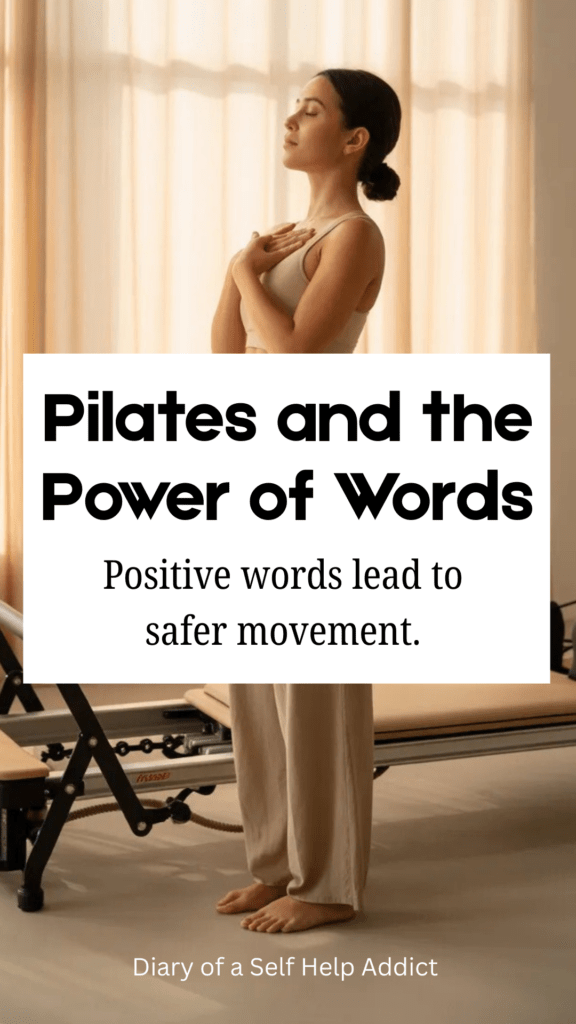
Years ago, I attended a Pilates workshop focused on the neuromuscular system—how the brain, nerves, muscles, and breath communicate.
The instructor reported that before her clients stepped onto the Pilates equipment, she asked them to say a positive word or statement, either silently or aloud. Words like “calm,” “safe,” “strong,” or “I trust my body.”
She explained that when clients arrived angry, stressed, or emotionally dysregulated, their bodies were more likely to brace, lose coordination, and move without awareness—making injury more likely.
Research on neuromuscular control indicates that emotional stress alters muscle firing patterns, balance, and reaction time.
A stressed nervous system moves differently than a regulated one.
When clients began sessions with intentional language and breath,… movement became smoother, safer, and more connected.
In Pilates, we don’t just train muscles—we train the brain-body conversation.
Words are part of that conversation.
The Bible on the Power of Words
Scripture has long emphasized what science is now confirming:
“Death and life are in the power of the tongue.” — Proverbs 18:21
“A gentle tongue is a tree of life.” — Proverbs 15:4
“When words are many, sin is not absent, but he who holds his tongue is wise.” — Proverbs 10:19
Words create outcomes. Silence, at times, is wisdom.
A Simple Word & Breath Exercise
- Sit comfortably and soften your shoulders.
- Choose a positive word: love, peace, joy, strength, kindness.
- Inhale and silently think about the word you chose.
- Imagine breathing its energy into your body.
- Exhale and imagine sending that word into the room around you.
Notice your breath. Your posture. Your mood.
Words are felt—not just heard.
Kelly’s Thoughts
If I’m being honest, I wrote this as much for myself as for anyone else.
I needed this reminder.
A reminder to soften my words. To notice when I’m being cynical, sharp, or unnecessarily hard on myself and on others. A reminder that even when I don’t say something out loud, my body still hears it. My nervous system still responds. My spirit still absorbs it.
It’s easy to dismiss words as harmless or sarcastic or “just how I talk,” but over time, those small phrases add up. They create patterns and shape how safe we feel in our own bodies. They influence how we move, how we heal, and how we show up in the world.
This isn’t about toxic positivity or pretending everything is fine. It’s about choosing language that supports growth instead of reinforcing struggle. It’s about learning to speak to ourselves the way we would speak to someone we deeply care about.
So this is my gentle reminder—to myself first:
To pause, breathe, and choose words that bring life instead of weight.
Because words shape worlds.
And I want mine to feel a little softer, a little kinder, and a lot more alive.
Remember, words shape our nervous system, our movement, our healing, and our relationships.
Always speak with intention. Speak with care. Speak life.
Mind-Body Resources for Positive Language
The Power of Positive Words: What You Say Makes a Difference by Stan Toler
Positive Words, Powerful Results: Simple Ways to Honor, Affirm, and Celebrate Life by Hal Urban
The Body Keeps the Score: Brain, Mind, and Body in the Healing of Trauma by Bessel Van der Kolk
The Gratitude Effect: Transform Your Life in Minutes a Day Through Mindful Appreciation by Fleur Jean
RESET WITH GRATITUDE & AFFIRMATION: A Daily 5-Minute Journal & Science-Backed Guide To Reprogram Your Mind & Improve Your Life by Elion Ben-Kellor
As an Amazon Affiliate, I may earn a small commission on some purchases through my links at no extra cost to you. Thank you for supporting my small business! Read my privacy policy and disclosure here.
Pin it for later

Love this post! I 100% agree that everything has energy and what we say affects our body. The mind and our own words are very powerful things.
They really are powerful and I’m learning that more and more everyday! : )
Love this reminder, and I agree that words, thoughts, and energy are powerful!
Thank you, Kara! : )