
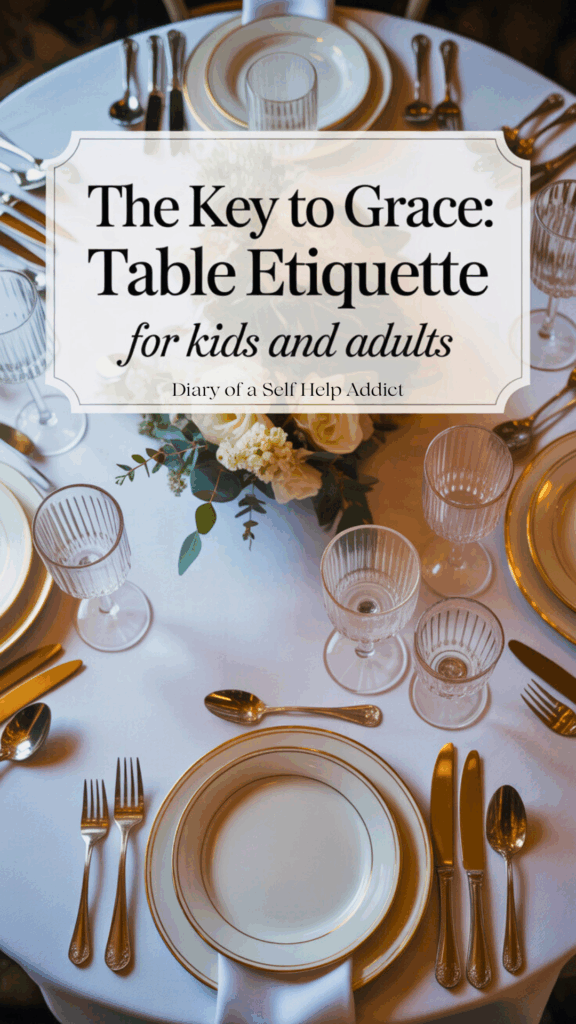
Years ago, I dreamed of starting a business called The Key to Grace to teach children etiquette. I even took a full etiquette course, covering everything from introductions to multi-course meals.
But life intervened. Between raising my daughter, working at the hospital, running my studio, and simply living, I never managed to launch the business as I imagined.
Still, I’ve come to realize something important—and it reassures me: that knowledge didn’t go to waste.
Though I never opened The Key to Grace, I lived its lessons. I taught my daughter what my grandmother taught me… grace, confidence, and kindness. Now, out at dinner or hosting guests, I see those lessons in her: quiet, natural, beautiful.
So today, I want to share some of those timeless etiquette lessons —the same ones my grandmother passed to me, that I passed to my daughter, and that anyone (at any age!) can benefit from. These are the little things that add up to grace.
1. How to Set a Formal Table — and What Order to Use the Utensils
One of my earliest memories of learning etiquette was helping my grandmother set the table for Sunday dinners. I loved how everything had a place — forks on one side, knives on the other, and napkins folded just so.
Here’s the basic rule:
- Forks on the left, knives and spoons on the right.
- The knife blade faces the plate (a sign of safety and courtesy).
- The napkin goes to the left of the forks or neatly on the plate.
- And if there are multiple forks or spoons? You simply start from the outside and work your way in with each course.
That’s it — the secret that impresses people at every formal dinner.
So when you see three forks sitting beside your plate and panic about which one to use first — just remember: outside-in.
A fun tidbit: my grandmother used to test me before big family dinners. She’d mix up the silverware and have me “fix it.” When she was young, I did the same thing with my daughter. It became this little game, and she got it right every time.
Related Read: THE ONLY MEATLOAF I’VE EVER LOVED (BESIDES MY MOM’S): TRISHA YEARWOOD’S CLASSIC MEATLOAF RECIPE
2. Don’t Sit Until the Hostess Sits
This one pairs beautifully with the previous rule. If you’re invited somewhere, especially to a more formal dinner, it’s proper to wait until the hostess has taken her seat before you do.
The meaning behind this tradition is simple: it’s a gesture of respect. It acknowledges that you’re there at someone else’s invitation and honors their role in hosting you.
When I taught my daughter this, I told her, “You don’t have to make a show of it — just wait naturally.” You can stand by your chair, chat casually, and then sit when your host does. It’s subtle, but it’s noticed.
3. Wait for the Hostess (or Head of the Table) to Begin
This one’s simple but says so much about respect and self-restraint.
My grandmother drilled this into me: You don’t pick up your utensils until the hostess does.
Why? Because it shows awareness and courtesy. It acknowledges that you’re a guest in someone else’s space — even if it’s just a dinner with friends.
At formal events or family gatherings, the “head of the table”—often the hostess or guest of honor—signals the meal’s start.
And let me tell you — this is one of those etiquette rules that people notice, even if they can’t quite explain why. It shows poise. It shows that you were taught manners. And it leads others to follow with the same etiquette.
That’s The Key to Grace in action — quietly, confidently, and gently guiding others without judgment.
4. For Boys and Young Men — The Gentleman’s Gesture
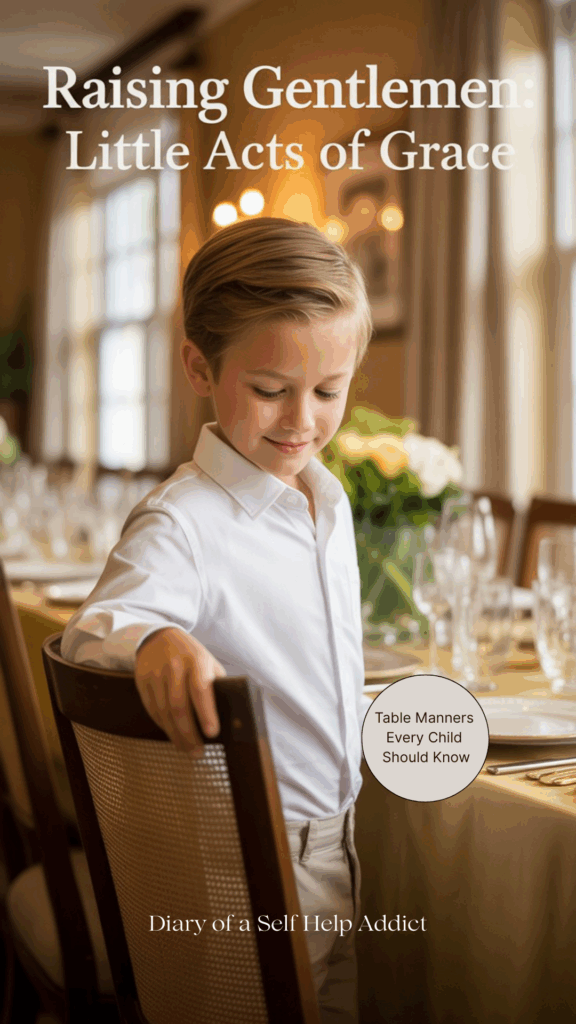
One of the first things my grandmother told the boys in our family was: “A true gentleman pulls out the chair for a lady.”
That small gesture isn’t about being old-fashioned — it’s about being thoughtful. Whether it’s your mother, sister, date, or friend, helping someone with their chair shows awareness and respect.
I’ve always told my daughter that grace isn’t just for girls — and I’ve told the boys in our circle that courtesy isn’t weakness. It’s strength wrapped in kindness.
A young man who stands when a woman approaches the table or who helps someone find their seat will always leave a good impression, not because he’s following an outdated rule, but because he’s demonstrating good character.
That, to me, is timeless grace.
5. Chew with Your Mouth Closed (and Other Table Manners That Matter)
This might seem like it goes without saying. Yet, trust me—people often forget it.
Chewing with your mouth closed shows self-control, respect, and awareness. Nobody wants to see or hear what’s happening in someone’s mouth during dinner!
It’s not just about chewing; it’s also about avoiding talking with food in your mouth, taking small bites, and placing your fork down while chewing — which brings us to the next point.
When I was teaching my daughter, I used to exaggerate this one a bit for fun. If we were eating together and she started talking mid-bite, I’d raise my eyebrows and point to my closed mouth. She’d giggle, finish chewing, and then continue her sentence properly.
Years later, the roles have reversed—she’s the one gently nudging me now when my dinner conversation gets too chatty. It’s funny how the tables have truly turned, both literally and figuratively.
6. Keep Your Elbows (and Arms) Tucked In
This practical, elegant tip makes a difference—especially at crowded tables.
When you’re cutting your food, keep your elbows close to your sides. Not only does it prevent accidental elbow-bumping with your neighbors, but it also looks much more graceful.
Grandmother used to say, “The mark of a well-mannered person is how little space they take up when eating.”
She didn’t mean shrink yourself — she meant be aware of others around you. Eat neatly, move thoughtfully, and don’t let your movements spill into someone else’s space.
It’s a small habit that signals refinement — and believe me, people notice.
Related Read: A SLICE OF NOSTALGIA: MY FAVORITE NO-BAKE RED VELVET PIE
7. Set Your Utensils Down While Chewing
This is one of those subtle gestures that truly separates good manners from great ones.
When chewing, rest your utensils on your plate. Holding them looks tense and risks accidental movement—it’s not graceful.
Proper etiquette says:
- When pausing between bites, place your utensils on your plate — knife and fork slightly apart in an inverted “V” or crossed, depending on your preference.
- When you’re finished, place them together diagonally (usually at the 4 o’clock position) to signal that you’re done.
It’s a tiny thing, but these details speak volumes about composure and mindfulness.
When I taught this to my daughter, I used to call it “resting your hands.” It made it feel natural — not rigid or fussy. After all, good manners should feel comfortable, not constrained.
8. What to Do When Eating a Roll or Slice of Bread
Ah, the bread course — one of the easiest ways to spot who’s learned proper dining etiquette.
Here’s the rule: Never butter the whole roll at once.
Instead, you should:
- Break off a small piece of bread (about two bites).
- Butter that small piece — not the entire roll.
- Eat it one piece at a time.
The bread plate sits to your left, and your drink glass is to your right. And yes, I taught this to my daughter. It saved her from that awkward “which glass is mine?” moment at a wedding when she was about ten.
9. Napkin Etiquette — The Unsung Hero
Let’s talk about napkins —they do more than just protect your outfit.
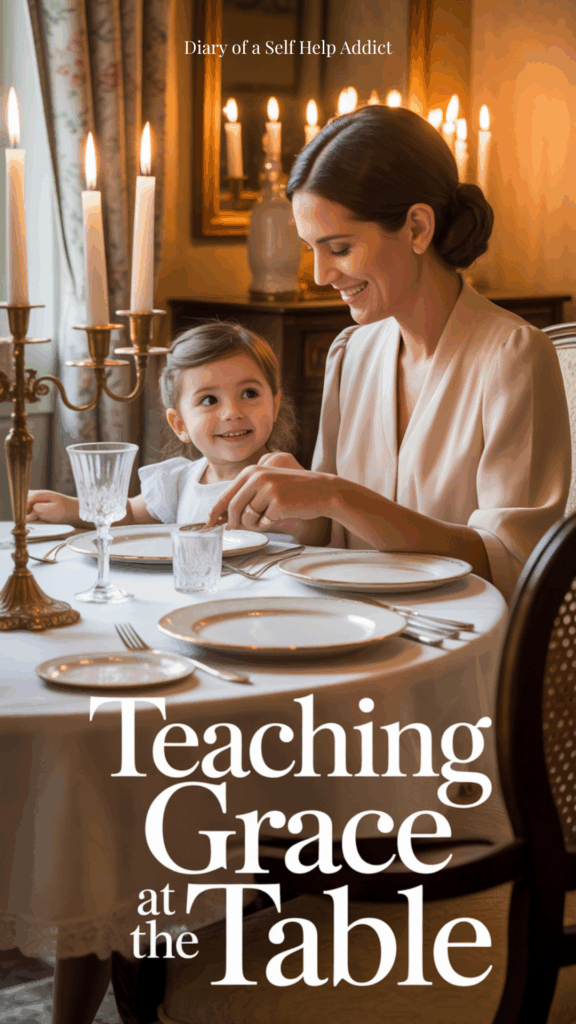
As soon as you sit down, place your napkin on your lap (never tuck it into your collar). If you need to excuse yourself, place it neatly on your chair, not the table. When you’re finished eating, fold it loosely and place it to the left of your plate — not crumpled on top of it.
I remember my grandmother always smoothing her napkin before setting it down. “Grace is in the details,” she’d say. And she was right.
10. How to Handle Conversations at the Table
Table manners go beyond forks and knives — grace extends to how you make others feel.
A graceful guest knows how to balance conversation and listening. That means:
- Avoid controversial topics at formal dinners (no politics, religion, or gossip).
- Include quieter guests in the conversation.
- Make eye contact and smile.
- Don’t interrupt.
- And always, always say thank you to your host.
Some of my favorite memories are of long dinners where conversation flowed naturally — stories, laughter, and warmth. Those are the moments that stick. The food might fade, but kindness never does.
11. Be Gracious — Always
At its core, etiquette isn’t about rules; it’s about respect and making people feel comfortable, seen, and valued.
Those lessons aren’t just tradition—they’re lasting skills for life. Even without my business, The Key to Grace lives on in each shared meal, kind interaction, or quiet act of respect my daughter and I pass forward. The real takeaway: etiquette is a daily practice of kindness and confidence that positively shapes every table we gather around.
Grace isn’t about being perfect — it’s about being present. It’s about knowing when to speak, when to listen, and when to simply smile.
There’s a quiet confidence that comes from knowing you can walk into any setting — a black-tie event, a dinner party, or even a coffee meeting — and handle yourself with poise.
And maybe, that’s really what The Key to Grace has always been about.
Kelly’s Thoughts — Passing Grace Forward
Even though I never officially launched my business, The Key to Grace still lives on in the lessons I’ve taught, in the way I carry myself, and in the small moments when my daughter naturally mirrors the manners I once learned at my grandmother’s table.
You don’t have to host formal dinners or memorize every rule to embrace etiquette. You just need to approach every interaction — every meal, every introduction, every thank-you — with awareness and kindness.
Because that’s what grace really is: the blend of good manners, thoughtfulness, and heart.
And it’s never too late to pass it on.
If my grandmother were here, she’d smile and say, “Now that’s how a lady does it.”
And honestly, I think she’d be proud.
Pin it for later
These are such great tips!
I am benefiting from reading this and I’m over 50. Love this read!
I’m so glad I got a chance to read this. It is easy to take for granted that these are just things I innately know. Thank you for the reminder to be intentional about teaching these skills to my little one.
I love this! These were all taught to me as well in some way or another, but it’s so great to see it all in one place in an easy to understand way.
I didn’t know about setting utensil down while chewing. Though i do anyway because of toddlers. Lol. Great tips.
This brought back memories of my own grandmother’s gentle wisdom!