

If you’ve followed me for a while, you know I’m a curious soul when it comes to optimizing health and longevity — especially when it comes to natural or biological tools that help the body do what it was designed to do.
I recently ordered a vial of LL-37 from my favorite peptide source, AMC Essentials (formerly AC Peptides) — you can use my referral link here for 10% off your first order. I’m not an affiliate, but I do get a small discount on my own purchases when someone uses my link.
I haven’t used LL-37 yet… I ordered it to have on hand “just in case” I come down with something this winter, but before I even consider trying it, I wanted to do a deep dive on what this peptide really is, what it does, and whether it’s something worth having ready in the wellness toolkit.
Let’s start by unpacking what LL-37 is and why it stands out.
What Is LL-37?
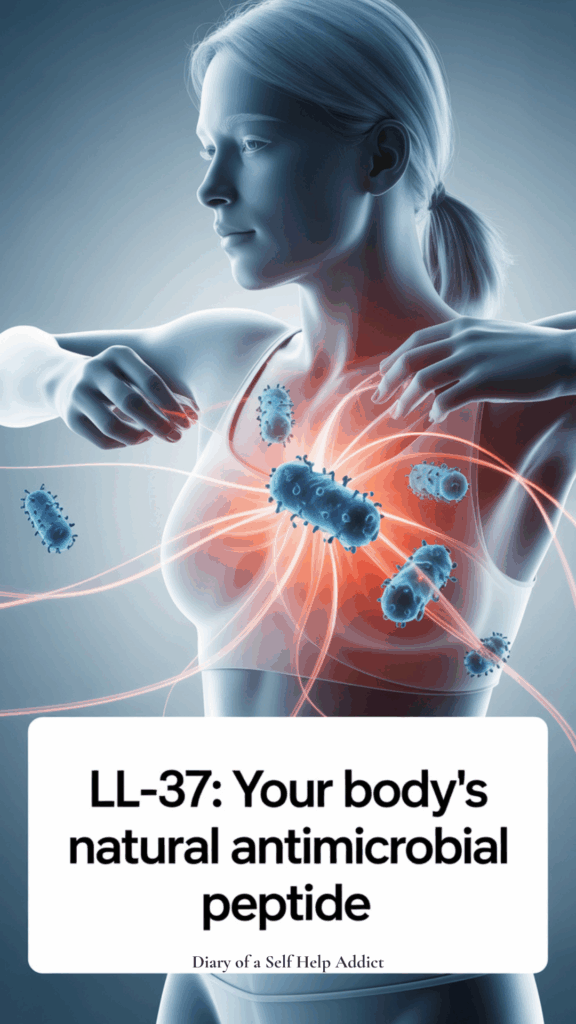
LL-37 is a naturally occurring peptide found inside our own immune system. LL-37 is the only one of its kind in the human body. It belongs to a group of tiny proteins that help protect us from germs — kind of like your body’s first superhero team that fights off bad bacteria and viruses.
It’s produced from a larger “parent” protein called hCAP-18, which your immune cells (especially neutrophils) store and release when they sense infection or tissue damage. When hCAP-18 gets clipped by certain enzymes, it releases the active fragment known as LL-37 (named for its first two amino acids, leucine-leucine, and its total of 37 amino acids).
Because it’s both positively charged and partially fat-loving (what scientists call “amphipathic”), LL-37 can attach to microbial membranes and literally poke holes in them — killing bacteria, fungi, and even viruses on contact. But it doesn’t stop there.
LL-37 is also immunomodulatory, anti-inflammatory, and tissue-repairing. In other words, it’s like having a microscopic first responder that not only fights infection but also helps calm inflammation and heal the damage afterward.
Related Read: MY TRIAL WITH METHYLENE BLUE: ENERGY, IMMUNITY, AND BEYOND
How LL-37 Works in the Body
Research has found that LL-37 is incredibly multi-talented. Here are a few of its better-known (and some lesser-known) roles:
🦠 Antimicrobial Powerhouse
LL-37 has been shown to destroy a wide range of pathogens — bacteria, viruses, and fungi — by breaking down their outer membranes. It even helps prevent the formation of biofilms, those sticky bacterial colonies that make infections harder to treat.
🧬 Immune Modulator
It doesn’t just kill germs — LL-37 also communicates with your immune system. It can attract immune cells, such as neutrophils and monocytes, to the site of infection and then calm inflammation once the danger is over. Interestingly, it’s been studied for its ability to balance immune responses — turning them up when the body needs help fighting, and dialing them down when inflammation becomes excessive.
💉 Wound Healer and Repair Agent
LL-37 promotes the growth of new blood vessels and encourages skin cells to migrate and close wounds more quickly. In fact, several studies have used LL-37 topically for the treatment of chronic ulcers and skin injuries, with promising results.
❤️ Potential Anticancer and Antiviral Roles
Early (and I do mean early) studies suggest LL-37 may have roles in preventing tumor growth and limiting viral replication. There’s still a lot to learn here, but it speaks to how dynamic this tiny peptide really is.
In short: LL-37 helps your body see invaders, fight them, and repair the battlefield once the job’s done.
A Quick History of LL-37
LL-37 was first discovered in the mid-1990s during research on natural antimicrobial defenses in humans. Scientists noticed that certain immune cells secreted a protein with broad antibacterial properties — and when they isolated and sequenced it, LL-37 was born.
Since then, researchers have explored synthetic versions, hybrid peptides, and delivery systems such as hydrogels or nanoparticles to help LL-37 survive longer in the body (it breaks down quickly). Most of this work has remained preclinical, but there have been some small human trials, mainly in topical wound healing, with encouraging safety results.
That said, systemic (whole-body) use in humans remains experimental.
When Might LL-37 Be Useful?
To be clear, LL-37 isn’t a “take it every day to feel great” kind of peptide. It’s more like a situational responder: something that could potentially support your immune system during times of acute stress, infection, or tissue injury.
Here’s where it’s currently being explored:
| Acute infections (viral, bacterial, fungal) | Directly disrupts microbes and may support immune balance. | Preclinical and some early human data. |
| Chronic wounds or ulcers | Stimulates healing, new blood vessels, and tissue repair. | Small topical human studies. |
| Biofilm-related infections | Can break down bacterial biofilms that resist antibiotics. | In vitro and animal models. |
| Post-viral immune imbalance / long COVID | Helps rebalance immune signaling. | Mostly theoretical at this stage. |
| General immune support “on hand” use | Could serve as a backup for early illness intervention. | Anecdotal only; use caution. |
Who Might Benefit (and Who Should Be Careful)
May Benefit:
- Those prone to frequent infections or slow healing.
- People recovering from viral or bacterial illness who want to support innate immunity.
- Individuals interested in immune optimization during cold/flu season.
Should Use Caution:
- Anyone with an autoimmune disease (LL-37 can sometimes amplify inflammation).
- Those with heart disease or vascular issues, as some studies link excessive LL-37 to plaque instability.
- Pregnant or breastfeeding women — there’s just not enough data.
- Anyone taking immunosuppressive medications.
If in doubt, always review with a medical professional first.
LL-37 vs. Thymosin Alpha-1: What’s the Difference?
You’ve probably heard of another popular immune peptide: Thymosin Alpha-1 (Tα1). So how does LL-37 compare?
| Feature | LL-37 | Thymosin Alpha-1 (Tα1) |
|---|---|---|
| Main Role | Innate immune defense, antimicrobial, wound repair | Adaptive immune modulator (supports T-cell function) |
| Antimicrobial Action | Strong — directly kills bacteria, viruses, and fungi | Minimal — works indirectly through immune balance |
| Inflammation Effect | Can raise or lower inflammation depending on need | Generally calming and balancing for immune response |
| Regulatory Status | Experimental / preclinical | Approved in some countries (used for hepatitis, immune support) |
| Ideal Use | Acute infection, wound healing, short-term immune support | Chronic immune weakness, viral suppression, immune balancing |
| Human Data | Limited but growing research | Well-documented in clinical studies |
| Mechanism Summary | Acts as the body’s first responder — kills germs and repairs tissue | Acts as the commander — trains immune cells and maintains order |
Think of it this way: LL-37 is the body’s frontline soldier, while Thymosin Alpha-1 is the commander who trains and regulates the immune army.
They can complement each other beautifully when used under proper guidance.
Related Read: THYMOSIN ALPHA-1: THE IMMUNE-BOOSTING PEPTIDE I WISH I KNEW ABOUT IN 2020
How LL-37 Is Typically Administered
Because LL-37 is still an experimental peptide, there isn’t an official “recommended dose.” What’s known so far comes from preclinical research and limited practitioner experience.
Common Delivery Routes:
- Subcutaneous injection — most popular and relatively easy to self-administer.
- Intramuscular injection — deeper injection, slower release.
- Topical / Local — for wounds or ulcers (usually mixed into a sterile gel).
- Intravenous — occasionally used clinically, but only under supervision.
Reported Experimental Dosing Ranges
(For educational purposes only — not a recommendation)
- 0.5–2 mg per injection (subcutaneous or intramuscular)
- Frequency: daily or every other day for a few days, depending on symptoms
- Topical doses are far lower — around 0.1–0.5 mg per site in wound studies.
Because every BODY and every immune response is unique, less is usually more. As with any peptide, start at a very low dose to assess tolerance before increasing it.
Storage & Handling
LL-37 is fragile. Store refrigerated (or frozen for long-term), keep it out of light, and reconstitute only with bacteriostatic or sterile water using sterile technique.
When to Use LL-37 (If Ever)
If I ever choose to use LL-37 personally, here’s how I’d think about it:
- At the very first signs of illness: scratchy throat, body aches, fatigue.
- Short-term: typically for 3–5 days at most.
- Supportively: along with hydration, rest, vitamin D, and all the basics of immune care.
- Never preventatively or long-term: it’s not a daily supplement.
I’d keep careful notes on dose, timing, and response — and stop immediately if I experienced anything unusual.
Potential Side Effects & Risks
Because LL-37 acts directly on cell membranes and immune pathways, overdoing it could backfire. Possible risks include:
- Local irritation or inflammation at the injection site
- Excessive immune activation (cytokine flare)
- Tissue or cell membrane irritation at high doses
- Allergic reactions or rash
- Unknown effects on chronic inflammation or autoimmunity
There’s also some evidence that too much LL-37 could contribute to atherosclerosis (plaque instability) — again, underscoring the importance of cautious, intermittent, and medically supervised use.
How It Might Fit into an Immune Support Toolkit
For me, LL-37 is something to have in reserve — not something I’d jump to first. I see it as a potential “back-pocket” option when:
- I feel a virus coming on and want to support innate immunity early.
- I’m recovering from something that hit my system hard.
- Or I’m managing inflammation after an infection.
For day-to-day immune support, I still rely on the basics: restorative sleep, real food, smart stress management, and the less glamorous things that actually move the needle.
If I ever use LL-37, I’d likely pair it with Thymosin Alpha-1 or KPV peptide for a more balanced immune response — but that’s a topic for another blog post.
Related Read: 5 MUST-HAVE SUPPLEMENTS FOR YOUR NATURAL MEDICINE CABINET THIS FALL
Kelly’s Thoughts
LL-37 is a very intriguing peptide — part of our own biology, yet powerful enough to be considered as a future therapeutic for infection, wound healing, and immune regulation.
For now, I’m content to let it sit in my peptide fridge as a “break glass in case of emergency” option.
If that day comes, I’ll use it carefully, thoughtfully, and always with medical guidance.
If you’re curious and want to learn more (or order your own to have on hand), you can find it through AMC Essentials. You’ll get 10% off your first order, and I’ll get a small discount on my next peptide purchase.
Either way — keep researching, keep questioning, and keep supporting your body’s own natural defenses. The more you understand how it all works, the more empowered you are to take control of your health.
Medical Disclaimer
This content is for educational purposes only and is not intended to diagnose, treat, cure, or prevent any disease. I’m not a doctor. The peptide LL-37 is considered experimental and not approved by the FDA for human use. Always consult a qualified healthcare provider before using any peptide or starting a new supplement or therapy, especially if you have existing health conditions, take medication, or are pregnant or nursing. Use at your own discretion, with safety and awareness as your top priority.
Pin it for later
Leave a Reply