
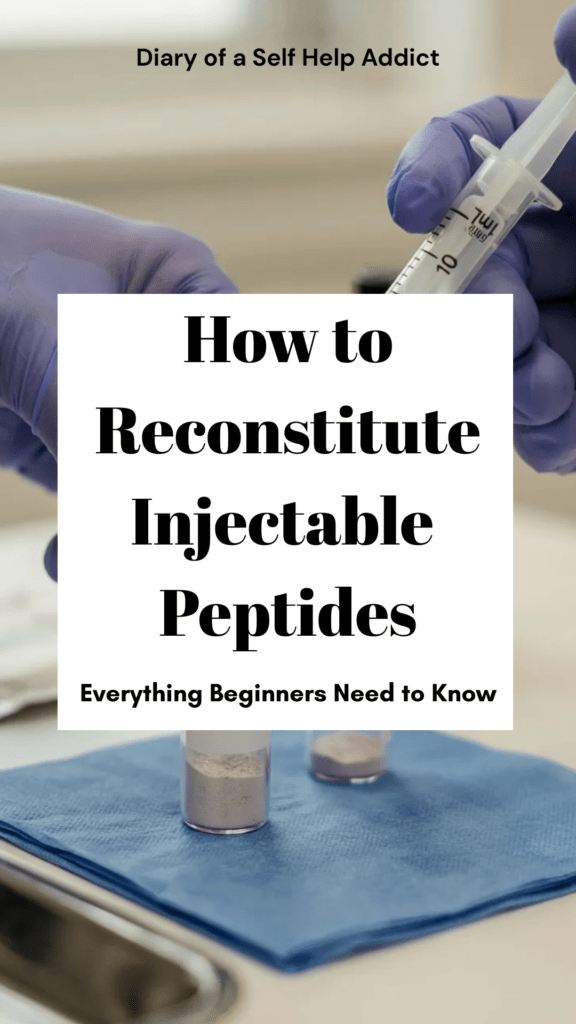
If you’ve recently started using injectable peptides, one of the most confusing parts isn’t choosing the peptide—it’s figuring out how to reconstitute it correctly.
I probably receive more questions about reconstitution than any other peptide topic.
- How much bacteriostatic water do I add?
- What syringes do I need?
- How do I calculate my dose?
- Why do some people add 1 mL while others add 2 or 3 mL?
- Can I inject this into muscle?
The good news? Once you understand a few basic concepts, peptide reconstitution becomes incredibly simple.
In this guide, I’ll walk you through exactly what you’ll need, why bacteriostatic saline is usually recommended, how to calculate concentrations, and how to prepare your peptide for subcutaneous injections safely.
Important Disclaimer: This article is for educational purposes only and reflects general information about peptide preparation. Always follow your healthcare provider’s guidance and the manufacturer’s recommendations for the specific product you’re using. Never inject anything that has not been prescribed or recommended by a qualified medical professional.
What Does “Reconstituting” a Peptide Mean?
Most injectable peptides arrive as a freeze-dried powder (lyophilized powder) in a sterile vial.
Before the peptide can be injected, sterile liquid must be added to dissolve the powder.
This process is called reconstitution.
Once dissolved, you’ll draw the solution into a syringe and administer it as directed.
Always Check the Manufacturer’s Instructions First
Before reconstituting any peptide, carefully read the manufacturer’s instructions or product insert. Different peptides may require different diluents, mixing volumes, storage conditions, or handling techniques. While many peptide users commonly use bacteriostatic saline, some products may instead recommend sterile water or another specific diluent. The manufacturer’s recommendations should always be followed, as they are specific to that product’s formulation and stability.
Why Use Bacteriostatic Saline (BAC Water)?
While some products are intended to be mixed with sterile water, many peptide manufacturers recommend bacteriostatic saline (or another specified diluent) because it contains a preservative that helps reduce bacterial growth after the vial has been punctured multiple times.
Always follow the manufacturer’s instructions for the specific peptide you’re using. Different products may recommend different diluents.
Bacteriostatic saline can often be purchased from peptide suppliers or from reputable medical supply companies such as BacteriostaticSaline.com.
Never substitute another liquid unless the manufacturer specifically states it is appropriate.
How Long Does Bacteriostatic Saline Last?
One question I get a lot is whether a bottle of bacteriostatic saline can be used until the printed expiration date.
The answer is: it depends.
An unopened bottle can generally be used until the manufacturer’s expiration date, provided it has been stored according to the label instructions.
However, once the vial has been punctured (opened), many manufacturers recommend discarding any remaining bacteriostatic saline after 30 days, even if the printed expiration date is much later. This recommendation helps reduce the risk of contamination from repeated needle punctures. I always write the open date on the vial with a black Sharpie, so I remember when to discard it.
As always, follow the manufacturer’s instructions for the specific product you’re using. If the solution becomes cloudy or discolored, contains particles, or you have any concerns about its sterility, discard it and use a new vial.
How Much Bacteriostatic Saline Should You Add?
This is where many beginners become confused.
Here’s the biggest thing to understand:
There is no magic amount. The amount of liquid you add does not change the amount of peptide in the vial. It only changes the concentration of the solution.
Think of it like making lemonade.
If you stir one packet of lemonade mix into one cup of water, it’s concentrated. If you stir that same packet into two cups of water, it’s less concentrated. You still have the same amount of lemonade mix.
Peptides work the same way.
The Most Common Reconstitution Volumes
Although manufacturer instructions should be followed first, you’ll often hear experienced peptide users recommend:
- 5 mg peptide → add 1 mL dilutent
- 10 mg peptide → add 2 mL dilutent
These aren’t rules. They’re easy math. Using these amounts makes calculating doses very straightforward.
Why Would You Add More Liquid?
Sometimes your prescribed dose is extremely small.
For example:
Say the peptide dose that you want to inject is only 0.125 mg.
If you only added 1 mL to a 10 mg peptide vial, your injection will be just a tiny fraction of a syringe.
That makes accurate measuring more difficult.
By adding more bacteriostatic saline, you increase the injection volume while keeping the peptide amount exactly the same. Many people actually find this easier and more accurate.
Again:
More liquid = less concentrated solution
Less liquid = more concentrated solution
The peptide amount never changes.
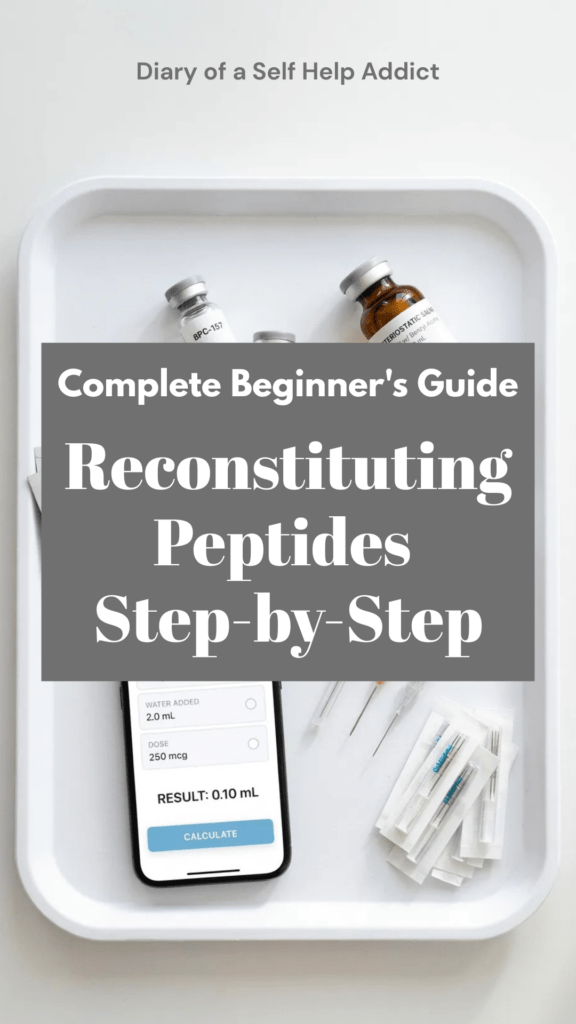
Keep Your Math Simple with Peptide Calc Pro
One of the best purchases I’ve made is the Peptide Calc Pro app. It’s only about $5 as a one-time purchase, and you own it for life.
Instead of doing calculations over and over, you simply enter:
- Peptide strength
- Amount of diluent (BAC water) added.
- Desired dose
- Size of the syringe you’ll be using to draw up the peptide.
The app instantly tells you exactly how much to draw into your syringe. It even shows a picture of a syringe so you can see where to draw up to.
Even better, it saves your previous calculations, so you don’t have to re-enter everything every time you use the same peptide.
If you’re using peptides regularly, it’s easily one of the most useful tools you can have.
How Much Liquid Fits in a Peptide Vial?
Another common misconception is assuming you can keep adding liquid indefinitely.
Most peptide vials physically hold 3 mL or less.
Some may hold more (such as glutathione or NAD+), but many standard peptide vials start to get quite full around the 3 mL mark.
Trying to force additional liquid into the vial isn’t recommended. Always pay attention to the manufacturer’s maximum recommended fill volume.
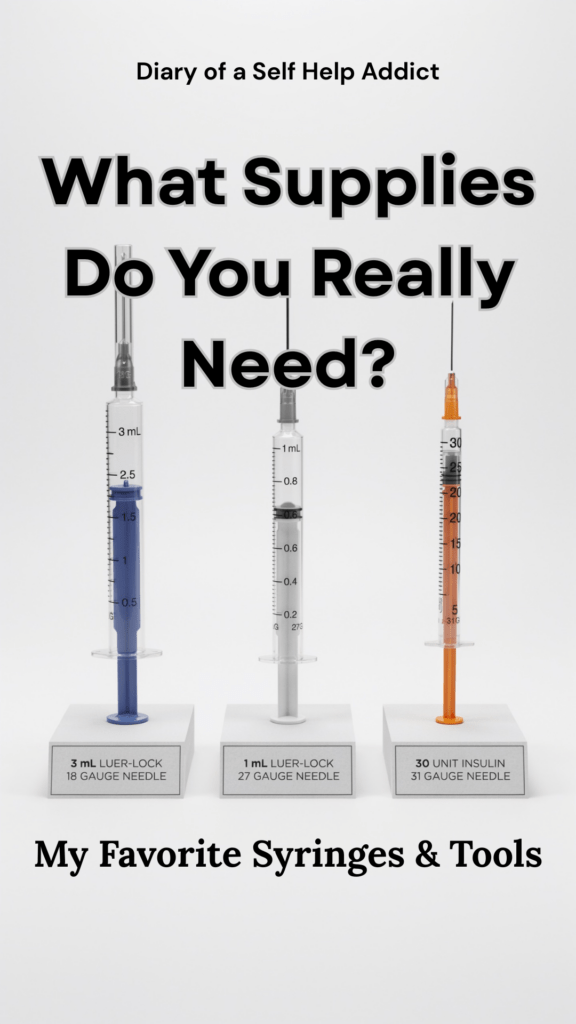
Supplies I Like to Keep on Hand
Everyone eventually develops their own preferences, but here’s what I personally like to keep stocked. These are the supplies that have worked well for me and make the reconstitution and injection process simple and convenient.
For most subcutaneous (SubQ) peptide injections, I prefer ½-inch to ⅝-inch needles. The goal is to deliver the peptide into the layer of fatty tissue just beneath the skin—not into the muscle.
Depending on your body type, the amount of subcutaneous fat at the injection site, and your healthcare provider’s guidance, a different needle length may occasionally be appropriate. Always follow the recommendations provided for your specific treatment and use proper injection technique to ensure the medication is delivered into the intended tissue layer.
Here are the syringes and needles I personally like to keep on hand:
3 mL Luer-Lock Syringes
I like using 3 mL luer-lock syringes paired with an 18-gauge needle to draw up bacteriostatic saline and reconstitute peptides.
The larger-bore needle makes drawing saline much faster than with tiny insulin needles. Since this syringe is only used for mixing (not injecting), it saves a lot of time.
1 mL Luer-Lock Syringes
For injections, I prefer 1 mL luer-lock syringes.
The nice thing about luer-lock syringes is that you can choose whichever needle size works best for your comfort.
I typically like:
The needle is thin enough to be comfortable while still allowing peptides to flow easily.
30 Unit Insulin Syringes
I also keep plenty of 30-unit insulin syringes on hand. These are especially helpful when I’m injecting a very small volume. Their smaller size makes tiny doses easier to measure accurately. Here’s another option.
I generally prefer:
- 31 gauge
- ½-inch to ⅝-inch needles
Because they’re so fine, injections are usually very comfortable.
Subcutaneous Injections Explained
Most injectable peptides are administered subcutaneously, often abbreviated as SubQ. A subcutaneous injection places the medication into the layer of fatty tissue just beneath the skin.
Common injection sites include:
- Abdomen (avoiding the belly button)
- Outer thighs
- Upper buttocks
- Love handle area
- Back of the upper arm (bat-wing area)
These areas contain enough fatty tissue to deliver the peptide comfortably.
What Is NOT a Subcutaneous Injection?
A subcutaneous injection is not the same as an intramuscular (IM) injection. IM injections are designed to place medication deep into the muscle using longer needles (1- 2 inches).
Common IM locations include:
- Deltoid (shoulder)
- Glute muscles
- Vastus lateralis (outer thigh muscle)
Most peptides are not intended to be administered intramuscularly unless specifically directed by the manufacturer or your healthcare provider.
Using the wrong injection technique may affect how the medication is absorbed. Always follow the product instructions.
Basic Steps for Reconstituting a Peptide
Although each manufacturer may have specific directions, the general process typically looks like this:
- Wash your hands thoroughly.
- Clean the rubber stoppers on both the bacteriostatic saline vial and the peptide vial with an alcohol prep pad.
- Draw the recommended amount of bacteriostatic saline into your larger syringe.
- Slowly inject the saline down the inside wall of the peptide vial rather than directly onto the powder.
- Allow the powder to dissolve naturally.
- Gently swirl the vial if needed. Do not shake it vigorously, as some peptides are delicate and can be damaged by excessive agitation. If the powder doesn’t dissolve immediately, don’t panic. Some peptides dissolve within seconds, while others may take several minutes. Be patient and avoid shaking the vial.
- Once the peptide has fully dissolved, store it according to the manufacturer’s recommendations.
- When you’re ready for your dose, use a smaller sterile syringe to draw up the prescribed or intended amount based on your reconstitution calculations.
- Clean the injection site with an alcohol prep pad and allow it to air dry.
- Administer the injection as directed for your specific treatment, using the appropriate injection technique.
General Storage Tips
Most reconstituted peptides and open BAC water should be refrigerated.
Avoid:
- Freezing unless specifically instructed
- Excessive heat
- Direct sunlight
- Leaving the vial at room temperature for prolonged periods
Always refer to the manufacturer’s storage recommendations, as different peptides may have different stability requirements.
Common Beginner Mistakes
Almost everyone worries they’ll do something wrong at first. Fortunately, most mistakes are easy to avoid.
Some of the most common include:
- Forgetting to disinfect vial tops
- Shaking the vial vigorously
- Using the wrong syringe for tiny doses
- Assuming more liquid changes the peptide strength
- Miscalculating concentrations
- Forgetting to label the vial with the reconstitution date
Reminder: Using a calculator app can eliminate most dosing errors caused by simple math.
Frequently Asked Questions
Does adding more bacteriostatic saline weaken the peptide?
No. The peptide contains the same amount of active ingredient. Adding more liquid decreases the concentration.
Can I add less liquid?
Usually yes, provided it is within the manufacturer’s recommendations, and the vial can still dissolve properly.
Less liquid creates a more concentrated solution. Be aware that a more concentrated solution may sting upon injection.
Why do experienced users use different amounts?
Personal preference.
Some people like tiny injection volumes. Others prefer slightly larger injections that are easier to measure accurately. Both approaches can be correct as long as the concentration is calculated accurately and manufacturer guidance is followed.
Can I use the same syringe for mixing and injecting?
It’s generally better to use separate sterile syringes and needles for each purpose.
Using a larger syringe for reconstitution and a fresh injection syringe for administration helps maintain sterility and accuracy. Plus, the more times you insert a needle through the rubber stopper, the more dull the needle becomes and can lead to a more painful injection into the skin.
Kelly’s Thoughts
Reconstituting peptides can seem intimidating the first time you do it, but once you understand concentration, it becomes much easier.
Remember these key takeaways:
- Always follow the manufacturer’s recommendations first.
- Bacteriostatic saline is commonly recommended because it contains a preservative that helps reduce bacterial growth after multiple punctures.
- Most peptide vials hold around 3 mL or less.
- Adding more liquid does not change the amount of peptide—only its concentration.
- Use the syringe that makes measuring your dose the easiest and most accurate.
- Most peptides are administered subcutaneously, not intramuscularly.
- A dosing calculator like Peptide Calc Pro can save you time, simplify calculations, and reduce errors.
Once you understand these fundamentals, you’ll have much more confidence preparing your peptides safely and accurately. I hope this guide answers many of the questions I receive every week and helps make the process feel far less intimidating for beginners.
If you found this article helpful, I’d love to hear from you! Leave a comment below and let me know what peptide topics you’d like me to cover next. Your questions often inspire my future articles.
If you’re just beginning your peptide journey, be sure to explore my other peptide guides, where I cover everything from choosing the right supplies to understanding common peptides, injection techniques, storage tips, and more.
And if you know someone who’s feeling overwhelmed by peptide reconstitution, please share this guide with them. It may save them time, confusion, and a lot of unnecessary math!
Happy learning!
Pin it for later
Medical Disclaimer: This article is intended for educational and informational purposes only and should not be considered medical advice. It is not intended to diagnose, treat, cure, or prevent any disease or medical condition. Always consult with a qualified healthcare professional before starting any new medication, peptide, or supplement. Only use products obtained from reputable sources, and always follow the manufacturer’s instructions for reconstitution, storage, handling, dosing, and administration. Individual products may have different recommendations, and those instructions should always take precedence over general information found online.
Leave a Reply