
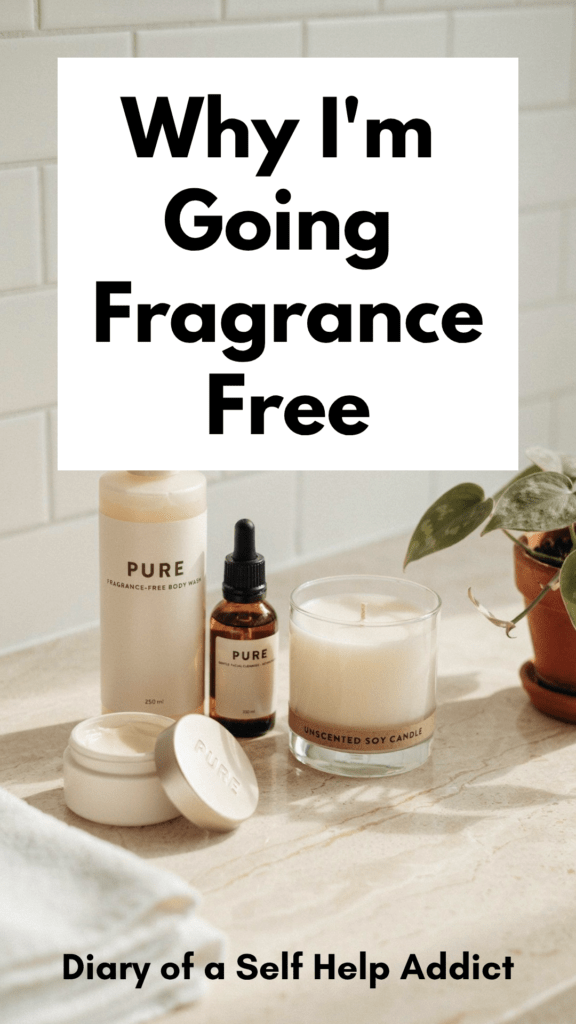
I’m going fragrance-free.
There. I said it.
And honestly? This is going to be HARD. Because I love things that smell good.
I’m not really a perfume person. I’ve never been one to douse myself in perfume or walk around smelling like a department store fragrance counter.
But candles? LOVE.
Essential oils? LOVE, LOVE.
Laundry detergent that makes your clothes smell amazing? YES, PLEASE.
Shampoo and conditioner that leave your hair smelling fresh and clean for hours? ABSOLUTELY.
A home that smells good? OF COURSE!
So why on earth would I voluntarily give all of that up? Because apparently my body has had enough. And my recent visit to the allergist confirmed what I’d suspected for a while: I am extremely sensitive to fragrance (and some other things, but more about that in a future post).
And when I say fragrance, I don’t just mean synthetic perfume. Here’s the part I really didn’t want to hear…
My allergist explained that if you’re sensitive or allergic to fragrance, essential oils are not a safe alternative.
I know. I know. That’s probably not what the “natural” crowd wants to hear. Believe me… neither did I!
But essential oils are concentrated aromatic substances, and they can cause allergic contact dermatitis and other reactions in sensitive people. In fact, essential oils are a recognized source of fragrance allergy, and some people can react to multiple oils because they share allergenic components.
So my beloved essential oils are officially on the chopping block too. Ugh.
But haven’t I always used fragrance?
Yep. And that’s part of what has made this whole thing so confusing. I’ve used scented products for YEARS. I didn’t suddenly wake up one morning and decide that fragrance was bad. Instead, I’ve noticed that my reactions have gradually gotten worse.
Sneezing. Itchy eyes. Sinus congestion. That lovely feeling of drainage down the back of my throat that makes me cough. Itchy skin. And just generally feeling miserable.
And lately, I’ve started wondering: Why is this getting worse? Is it perimenopause? Is it simply getting older? Have I become sensitized after years and years of exposure? Is there some other allergen involved? I don’t know. And I’m not going to pretend I do.
But I do know fragrance is a major trigger for me, and my allergist confirmed I am highly sensitive to it.
At some point, you have to stop arguing with your body. So I’m listening.
Is Fragrance Really THAT Bad?
This is where I want to be careful. I’m not saying everyone needs to eliminate every scented product from their home. I’m also not saying every fragrance ingredient is “toxic” or that using a scented shampoo will make you sick.
This post isn’t about that. If fragrance doesn’t bother you, that’s a different situation.
But if you get itchy skin, watery eyes, congestion, headaches, coughing, or other symptoms around fragranced products, it may be worth paying attention.
Fragrance allergy is a recognized cause of allergic contact dermatitis. And fragrance isn’t limited to perfume.
It can show up in shampoo, conditioner, lotion, deodorant, laundry detergent, fabric softener, cleaning products, makeup, candles, air fresheners, and much more.
Once I started looking for it, I realized: Fragrance is EVERYWHERE. And that made me curious.
What exactly does the word “fragrance” even mean?
But What Exactly IS “Fragrance”, And What’s Actually In It?
Here’s something I didn’t really understand before going down this rabbit hole: Fragrance isn’t necessarily one ingredient.
What you see listed on a cosmetic bottle simply as fragrance or parfum can represent a mixture of multiple aromatic ingredients. Those ingredients may be synthetic. They may be naturally derived. Or a combination of both.
And under current U.S. cosmetic labeling rules, the individual components of a fragrance mixture don’t necessarily have to be listed separately on the label.
Instead, you may see: Fragrance or Parfum. That’s it. So naturally, I started wondering… What’s actually in there? And that’s where things got interesting.
Phthalates
You’ve probably heard of phthalates. They’re actually a group of chemicals with many different uses… not one single ingredient.
One called diethyl phthalate, or DEP, has been used in fragrances as a solvent and fixative, helping fragrance ingredients blend and helping scent last.
According to the FDA, DEP appears to be the phthalate still commonly used in cosmetics. The FDA also currently states that it has no safety concerns about DEP at the levels at which it’s presently used in cosmetics and fragrances.
Please note that I’m not putting phthalates on a giant “BAD CHEMICALS!” list. I’m simply interested in knowing what’s potentially in the products I’m using. If something concerns me, I can research it further and decide for myself. And you can too.
VOCs
Then there are volatile organic compounds, or VOCs. Maybe you’ve heard that term before too.
A VOC isn’t automatically a dangerous chemical. It’s a huge category of carbon-containing compounds that can evaporate into the air.
VOCs can come from paints, cleaning products, air fresheners, personal-care products, and many other household products.
According to the EPA, some VOCs can cause negative health effects depending on the chemical, concentration, and amount of exposure, while others have little-known effects.
Possible effects from certain VOC exposures can include eye, nose, and throat irritation, headaches, nausea, and respiratory irritation.
What caught my attention wasn’t simply:
“VOCs are bad.” That’s way too simplistic. It was realizing how many things we release into the air inside our homes.
- Room sprays
- Cleaning sprays
- Air fresheners
- Scented products
- Candles
- Diffusers
And then… we breathe that air. That was worth thinking about.
What About Formaldehyde?
This one needs an important distinction. I don’t want to tell you: “Fragrance contains formaldehyde.” Because that’s not necessarily true.
After researching fragrance, what interested me is what can happen when certain chemicals are released into indoor air.
The EPA explains that chemicals associated with some scented products (specifically pine and citrus) can react with ozone in indoor air and create secondary pollutants, including formaldehyde and particulate matter.
I had never really thought about that.
It’s not necessarily just: What’s in the bottle?
There’s also the question: What happens after those chemicals are released into the air?
Again, I’m not saying your lemon-scented cleaner is poisoning you. I’m saying indoor air chemistry is a lot more complicated than I realized. And now that I’m paying attention to fragrance, I find that fascinating.
Synthetic Musks
Another category you may come across when researching fragrance is synthetic musks.
These fragrance chemicals are designed to create or enhance the soft, lingering musky scent found in many personal-care products and perfumes. (One of my favorite scents!)
Some synthetic musks have been studied because certain compounds can persist in the environment and have been detected in cells of humans and wildlife after environmental exposure.
Research continues into their potential environmental and health effects.
Again, I’m not including them because I’ve decided they’re automatically dangerous. I’m including them because they’re part of the fragrance conversation, and it’s worth knowing that they’re there.
And Then There Are Fragrance Allergens
This category is particularly interesting to me because fragrance allergy and sensitivity are the reason I started researching all of this in the first place.
Some fragrance compounds known to cause allergic reactions in susceptible people include:
- Limonene
- Linalool
- Citral
- Geraniol
- Citronellol
- Eugenol
- Cinnamal
- Coumarin
And here’s the kicker. Several of those occur naturally in plants and essential oils.
There goes my “But it’s natural!” argument. 😂
Which brings me back to what my allergist told me. An essential oil isn’t simply one “natural ingredient.” An essential oil can be a complicated mixture containing dozens (and sometimes more than 100) different chemical constituents.
Natural? Absolutely. But that doesn’t automatically mean non-allergenic. And synthetic doesn’t automatically mean harmful either.
A chemical isn’t automatically harmful because it’s synthetic, and it isn’t automatically harmless because it came from a plant. That’s one of my biggest takeaways from all of this research.
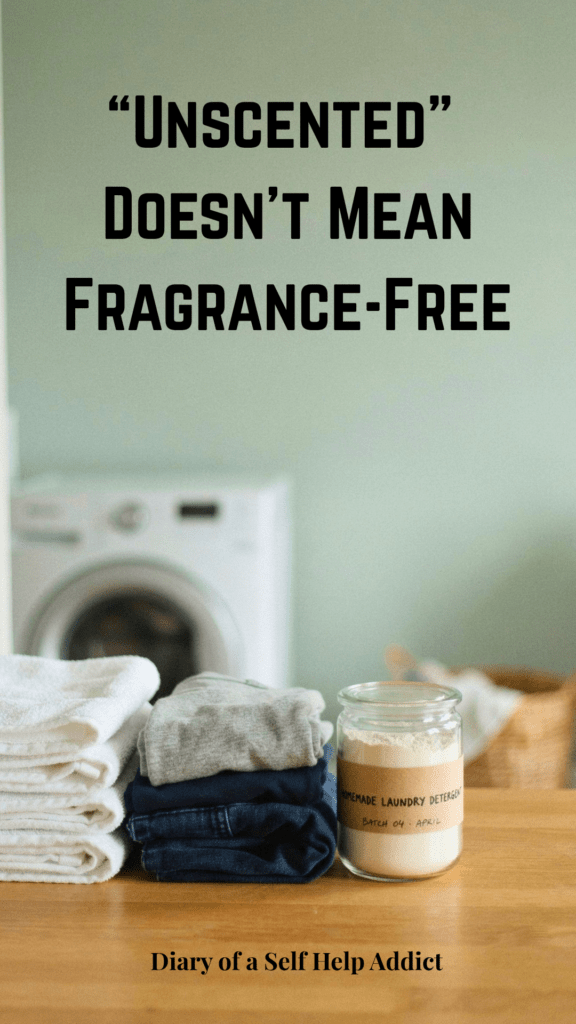
And “Unscented” Doesn’t Necessarily Mean Fragrance-Free
Oh, and here’s another big takeaway: a confusing little labeling issue I didn’t fully understand before. Unscented and fragrance-free aren’t necessarily the same thing. I used to think they were.
An “unscented” product may still contain fragrance ingredients used to mask the natural odor of other ingredients rather than to make the finished product smell pretty.
So technically… A product can smell like absolutely nothing… and still contain fragrance ingredients. Seriously?! 🤔
That’s why I’m now looking specifically for fragrance-free, rather than assuming “unscented” means the same thing.
I’m also learning not to trust words like:
Natural.
Clean.
Botanical.
Plant-based.
Green.
Unscented.
Those words may tell you something about a product. But they don’t necessarily tell you whether it contains fragrance. Read the label.
I’m Not Trying to Scare You Away From Fragrance
This is important enough to say again.
I’m not sharing information about phthalates, VOCs, synthetic musks, formaldehyde, or fragrance allergens so you’ll immediately run into your bathroom and throw everything away.
And I’m definitely not saying: CHEMICALS = BAD. Everything is made of chemicals.
I’m sharing it because I think it’s interesting to know what’s in (or may be associated witt) the products we use every single day.
You may research these ingredients and decide you’re perfectly comfortable continuing to use your favorite scented products. You may decide to cut back on a few. Or, like me, you may have a very practical reason for eliminating them: Your body doesn’t like fragrance.
Do your research. Look at reputable sources. Read labels. Ask questions. And make the decision that’s right for you.
For me? My itchy eyes, sneezing, congestion, coughing, and itchy skin have already cast their vote. So I’m going fragrance-free.
So…How Do You Actually Go Fragrance-Free?
This was my next question.
Because once I started looking around my house, I realized fragrance was EVERYWHERE.
And the idea of throwing half my house into garbage bags and starting over sounded expensive, wasteful, and completely overwhelming.
Thankfully, you don’t have to do that.
I’ve actually been slowly switching products for about a year. I’d replace something when it ran out. I made my own laundry detergent first. Then I switched to fragrance-free shampoo and conditioner. Started using other fragrance-free products here and there.
Meanwhile…
I still had scented candles. And essential oils. And diffusers in practically every room.
Basically: Halfway fragrance-free. LOL.
Now I’m ready to go full throttle. And if you need (or want) to reduce fragrance in your life too, here’s how I’d start.
1. Start With What You Put Directly on Your Body
Don’t try to replace everything at once.
Start with what touches your body every single day:
- Shampoo
- Conditioner
- Body wash
- Soap
- Lotion
- Deodorant
- Hair products
- Skincare
- Makeup
Hair products were one of the first things I changed. Think about it. You wash your hair with fragranced shampoo and conditioner, add styling products, dry it… Then your hair sits right beside your face and nose all day.
I switched to Project Goods fragrance-free shampoo and conditioner, (non-affiliate link) and so far I’m really liking them.
And here’s what surprised me: My hair doesn’t have to smell like something for it to be clean. Who knew? LOL.
I also make my own DIY dry shampoo, which I’ll link here because fragrance can sneak into that too.
I’ve also found other fragrance-free hair-care options, including Vanicream and SEEN Fragrance Free Shampoo and Conditioner.
I’m not an affiliate for these companies, however if you order from my Amazon links, I do earn a small commission at no extra cost to you. I’m sharing products I’m using and loving or researching as I make this switch.
And I’m not interested in recommending something simply because it says “fragrance-free.” I want it to actually WORK.
2. Tackle Your Laundry
This one hurt. Because I LOVE pulling clothes out of the dryer and smelling that delicious clean-laundry smell. You know the one.
Except… That smell isn’t what makes your laundry clean. It’s fragrance.
And think about how much contact you have with your laundry.
- Your clothes.
- Underwear.
- Pajamas.
- Sheets.
- Pillowcases.
- Towels.
You’re surrounded by whatever you’re washing those things in practically 24 hours a day.
I’ve actually been making my own laundry detergent for a few years, and one of the reasons I started had nothing to do with my current fragrance issues.
I started looking at the ingredient lists on some of the popular “free & clear” detergents and thinking:
Wait…what IS all of this stuff?
Even products marketed as free of perfumes and dyes can have fairly long ingredient lists filled with surfactants, enzymes, stabilizers, preservatives, and other ingredients I knew absolutely nothing about.
And let me be clear… because after all the research I’ve done for this post, I think this distinction matters: A long chemical name doesn’t automatically mean an ingredient is harmful. And an ingredient I can’t pronounce isn’t automatically bad for me.
But personally, it made me want to know more about what I was washing my clothes, sheets, and towels in every single week. That’s ultimately one of the reasons I started making my own detergent. I liked knowing exactly what I was putting in it.
Simple. Inexpensive. And no mystery ingredient list for me to decipher.
Now that I’m trying to eliminate fragrance too, it makes even more sense. And yes… I still occasionally buy Zum laundry detergent because I run out of homemade detergent, and I confess sometimes I’m just too lazy to make another batch.
But that has to go too. Even though I like Zum because the ingredient list is short and easy for me to understand, it’s still fragranced.
And that’s kind of the whole point of this journey I’m on. Fragrance-free means fragrance-free.
Not…
- “mostly fragrance-free.”
- “except when I’m tired.”
- “except when I want my towels to smell amazing.”
If DIY isn’t your thing, plenty of fragrance-free laundry detergents are available. Just remember what I’m learning throughout this whole process: “Fragrance-free” tells you something about fragrance. It doesn’t necessarily tell you everything about the rest of the formula.
So if the other ingredients matter to you too, flip the bottle over and read the ingredient list. Look up the ones you don’t recognize. Decide what you’re comfortable using rather than assuming a product is automatically better or worse because of what’s printed on the front of the bottle.
And don’t forget the other places fragrance can sneak into your laundry:
- Fabric softener
- Dryer sheets
- Scent boosters
- Laundry sprays
- Other fragranced laundry additives
I’ll share my homemade laundry detergent recipe soon too (apparently I just gave myself another blog post to write).I’ll share my homemade laundry detergent recipe soon too, because apparently I just gave myself another blog post to write.
3. Remove Things Whose Entire Job Is to Make Something Smell Good
This is one of the easiest places to start because you don’t even have to replace most of these products. You can simply stop using them.
Walk around your house and look for:
- Plug-in air fresheners
- Room sprays
- Wax melts
- Scented candles
- Potpourri
- Car air fresheners
- Fragrance diffusers
- Essential oil diffusers
Basically, if the entire purpose of the product is: “Make this room smell like something…” I’m questioning whether I need it.
I still love candles for the ambiance, so I’m switching to plain unscented beeswax candles.
I can still have the glow. The cozy feeling. And the ambiance.
My house just doesn’t need to smell like Pumpkin Pecan Waffle Explosion. 😆
4. Yes…Essential Oil Diffusers Count
This might be the hardest part for me.
We’ve had an essential oil diffuser in practically every room of our house for years.
I LOVE essential oils.
- The cute, little bottles.
- Experimenting with them.
- Adding them to homemade products.
And for years, I thought of them as the “natural” alternative to synthetic fragrance.
But if I’m genuinely trying to determine whether fragrance is contributing to my symptoms, I can’t remove synthetic fragrance while still pumping concentrated aromatic plant compounds into the air all day.
That doesn’t make much sense.
So for now? The diffusers are going off.
Maybe someday I’ll use essential oils again. Maybe I won’t.
But right now, I’m more interested in breathing comfortably than making my bedroom smell like lavender.
5. Go Through Your Cleaning Cabinet
This was another eye-opener. Think about how many products we use:
- Kitchen spray.
- Bathroom cleaner.
- Glass cleaner.
- Floor cleaner.
- Toilet cleaner.
- Dish soap.
- Dishwasher products.
- Disinfectant.
- Hand soap.
- Furniture spray.
And many of them are fragranced. I’m using this as an opportunity to simplify. I don’t need 15 different bottles under my sink.
I’m looking for fragrance-free products with transparent ingredient lists and, ideally, products that can do more than one job.
One option I’m researching is Branch Basics, because its cleaning concentrate is fragrance-free and can be diluted for different household cleaning jobs.
I LOVE the idea of fewer bottles.
And honestly, that’s becoming a theme of this whole journey:
Less stuff.
Fewer ingredients.
Fewer scents.
Fewer exposures.
6. Check Your Makeup and Skincare
This one will take me a little longer. Fragrance can show up in skincare and cosmetics too.
And remember: “Natural,” “botanical,” and “clean beauty” don’t necessarily mean fragrance-free.
So check:
- Facial cleanser
- Moisturizer
- Sunscreen
- Serums
- Foundation
- Concealer
- Blush
- Bronzer
- Lip products
- Makeup remover
- Setting sprays
I’m not throwing out my entire makeup drawer. I’m simply going through things as I use them and replacing products when necessary.
I’ve found fragrance-free options from brands such as Tower 28 and Almay, and I’m sure I’ll discover plenty more as I go.
But I’m going to keep taking my own advice: Read the individual label. Brands reformulate. Different products within the same brand can have different ingredients.
And “fragrance-free” doesn’t mean there’s no possibility of reacting to another ingredient. I’m trying to remove the category that is currently causing me a problem.
7. Look for Fragrance in the Weird Places
This is where going fragrance-free starts to feel like a scavenger hunt.
Because once you start looking, you’ll find fragrance in places you may never have considered.
Hand Soap
You use it multiple times every day.
Deodorant
Another product that sits on your skin for hours.
Body Lotion
This one can cover a huge portion of your skin.
Lip Balm
Especially flavored, botanical, or essential-oil-heavy versions.
Feminine Products
Look for fragrance-free pads, liners, and wipes.
Trash Bags
Yep. Some are scented. My garbage does not need to smell like lavender.
Toilet Paper and Tissues
Some varieties contain added fragrance or lotion.
Pet Products
Shampoo, deodorizing sprays, wipes, and bedding products may contain fragrance too.
Project Goods actually makes a fragrance-free dog shampoo, which caught my attention because apparently even Finley doesn’t need to walk around smelling like tropical coconut. 😂
Your Car
Take out those air fresheners. You’re sitting in a tiny enclosed space breathing that fragrance. And once you start looking…You realize just how much fragrance surrounds us.
8. Consider Making Your Bedroom Fragrance-Free First
If changing your entire house feels overwhelming, this is a GREAT place to begin. Think about how many hours you spend in your bedroom.
- Wash your sheets and pillowcases in fragrance-free detergent.
- Skip scented dryer sheets.
- Remove diffusers, candles, and room sprays.
- Check your night cream, body lotion, and hand cream.
- Use fragrance-free products before bed.
That gives you seven or eight hours every night in a lower-fragrance environment without overhauling your entire life. I like that.
As an Amazon Associate, I earn a small commission at no extra cost to you when you purchase from my links. Thank you for supporting my small business!
9. Don’t Throw Everything Away Overnight
I’m definitely not throwing half my house into a dumpster. For products that aren’t obviously bothering me, I may finish them instead of replacing them.
For something that clearly triggers symptoms? That’s different.
I will donate unopened products or give them to friends or family when appropriate.
One of my biggest rules now is: New products I buy will be fragrance-free.
I’m slowly working my way to a fragrance-free household instead of trying to accomplish it in one weekend.
10. Don’t Replace Synthetic Fragrance With “Natural” Fragrance
This is probably the biggest mistake I was making.
I stopped buying fragranced cleaner… but added essential oils to homemade cleaner.
Stopped using scented plug-ins… but started diffusing essential oils instead.
Then stopped using perfume… and used an essential-oil roller.
Except if you’re sensitive to fragrance, that may not solve the problem. It didn’t for me!
So at least while I’m trying to figure out what my body is reacting to, I’m getting comfortable with: Nothing smelling like anything.
Which feels surprisingly strange after decades of being taught that clean means:
- Fresh linen scent.
- Lavender fields.
- Mountain breeze.
- Ocean mist. (Whatever “ocean mist” is supposed to smell like. Lol!)
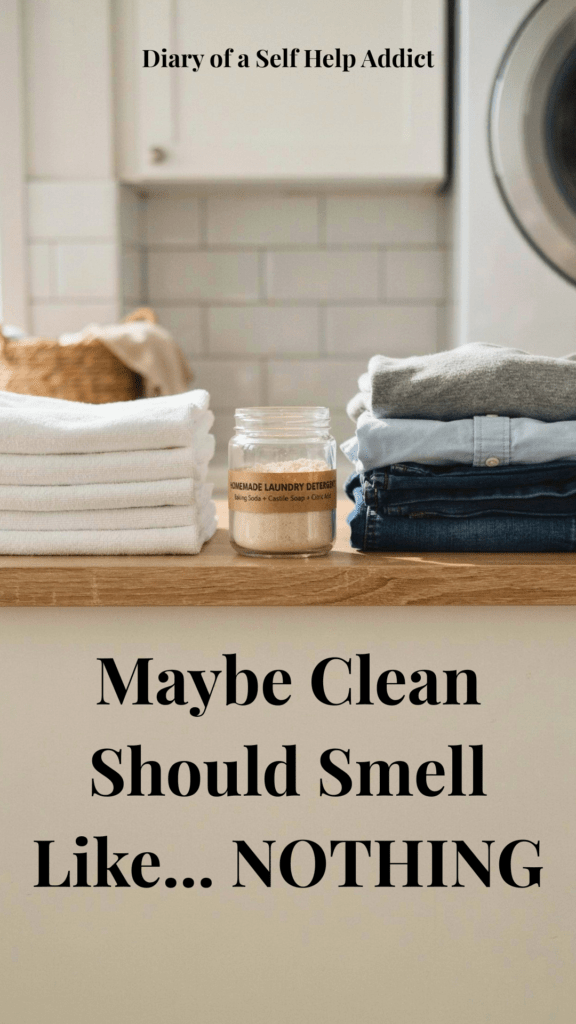
Maybe clean just smells like… nothing.
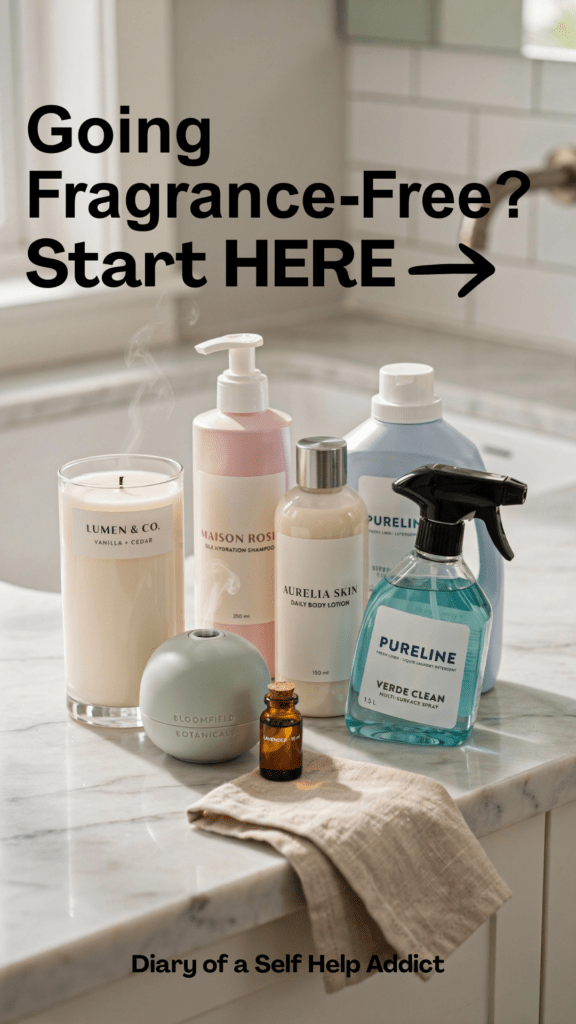
My Simple Fragrance-Free Game Plan
If this sounds completely overwhelming, here’s the short version.
First: Remove obvious fragrance sources like diffusers, air fresheners, room sprays, and scented candles.
Second: Change the products that stay closest to your body—shampoo, conditioner, soap, lotion, deodorant, and skincare.
Third: Switch your laundry products.
Fourth: Simplify your cleaning products and look for fragrance-free options.
Fifth: Work through the sneaky stuff as you find it.
And most importantly:
Give yourself time.
You do NOT have to overhaul your entire house in one weekend. I’ve already been gradually switching products for about a year. The difference now is that instead of being casually fragrance-free-ish… I’m actually committing to it.
What I’m Looking for When I Shop
My checklist is pretty simple:
Fragrance-free.
Not merely “unscented.”
I’m also watching out for “fragrance/parfum” on ingredient lists.
And because of what my allergist told me, I’m also looking out for essential oils and fragrant botanical ingredients.
I’m trying not to get sucked in by marketing terms like “natural,” “clean,” “green,” or “botanical.”
And I’m remembering: Fragrance-free does not automatically mean irritation-free.
Someone can react to all kinds of ingredients. This isn’t about finding one magically perfect product. It’s about removing one category of exposure that is a problem for me.
Is This Going to Be Easy?
Nope. I’m already mourning my essential oils.
I’m going to miss getting out of the shower and smelling my delicious shampoo.
I’m going to miss opening the dryer and getting hit with that “fresh laundry” smell.
I’ll miss my essential fall-scented candles.
But here’s what I want more: I want to feel good.
I don’t want…
- itchy eyes
- to sneeze all day.
- sinus congestion.
- drainage making me cough.
- itchy skin.
And I definitely don’t want to spend every day wondering what the heck is making me miserable.
Eliminating fragrance won’t solve every symptom.
I’m realistic enough to know other things could be going on.
But if fragrance is contributing to the problem, reducing my exposure is a reasonable place to start.
Maybe “Nothing” Is Actually a Pretty Wonderful Smell
This may be another lesson in getting older. Things I used to tolerate don’t always agree with me anymore. Things I used to love don’t necessarily serve me anymore. And fragrance may be another one of those things.
I’m not becoming the woman who says nobody should ever use perfume, candles, or essential oils. I’m simply becoming the woman who has finally realized: My body doesn’t seem to like them anymore.
And I’m ready to listen.
So I’ll keep sharing this experiment as I go… the products I’m replacing, my DIY recipes, the fragrance-free brands I actually like, the ones I don’t.
And most importantly: whether I actually feel any better.
I’ll link my DIY dry shampoo recipe here, and I’ll also share my homemade laundry detergent recipe soon.
Because if you’re reading this thinking: “Okay…but HOW do I actually go fragrance-free without losing my mind?”
My answer is: Start small. Start with what you use every day. Then work outward.
And maybe we’ll both discover that a clean house doesn’t have to smell like anything.
Clean clothes don’t have to smell like flowers.
Clean hair doesn’t have to smell like coconut.
And maybe “nothing” is actually a pretty wonderful smell.
Especially when “nothing” means I can breathe easier, my eyes aren’t itching… And my skin isn’t screaming at me.
Are You Fragrance-Free—or Thinking About It?
Now I want to hear from you.
Have you ever noticed that certain scents make you sneeze, itch, cough, get congested—or just feel off?
Have you tried going fragrance-free? If you have, what was the hardest thing to give up?
I’m still at the beginning of this experiment, so I’ll be sharing what I learn along the way—including the fragrance-free products I actually like, the ones I don’t, and some of my favorite DIY alternatives.
And if you’ve found a fragrance-free shampoo, laundry detergent, skincare product, cleaner—or anything else you absolutely LOVE—please share it in the comments! I’m taking recommendations.
If you enjoy figuring out this whole health-and-wellness thing right along with me, be sure to subscribe to Diary of a Self Help Addict so you don’t miss what I discover next.
Because apparently getting older means questioning everything you thought you knew…
Even whether your laundry actually needs to smell like a meadow.
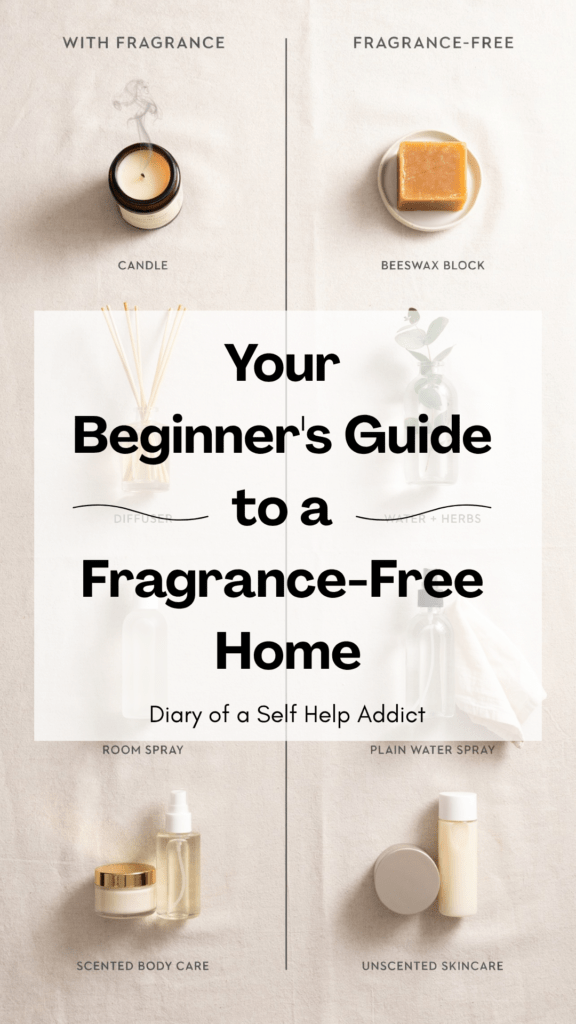
Pin it for later
One important note: I’m sharing my personal experience and what I’m learning along the way. I’m not suggesting that fragrance, phthalates, VOCs, essential oils, or any of the other ingredients discussed here are harmful to everyone, nor am I suggesting that your symptoms are caused by fragrance. If you’re experiencing persistent skin, respiratory, eye, or other symptoms, talk with your healthcare professional or allergist for an appropriate evaluation.
[…] Read more about my experience: WHY I’M GOING FRAGRANCE-FREE AND 10 TIPS ON HOW TO DO IT WITHOUT LOSING YOUR MIND […]