

Every morning, before I enjoy my first glorious cup of coffee, I do a few simple things to nourish my body, including eating a forkful of homemade sauerkraut and one Brazil nut.
That’s it. Nothing elaborate. No complicated supplement schedule. No powder to mix. No giant handful of vitamins to swallow.
The sauerkraut gives me a little fermented food first thing in the morning, and that single Brazil nut gives me something my body needs in only a very small amount: selenium.
I mentioned this little habit in my morning routine post (check out that article here); however, it deserved its own blog. Brazil nuts are one of the richest food sources of selenium, and one nut commonly contains more than the recommended daily amount for an adult.
But this is also one of those cases where more is definitely not better. Let’s talk about what selenium does, why Brazil nuts contain so much of it, and why I stop at one.
What Is Selenium?
Selenium is an essential trace mineral. “Essential” means our bodies need it but cannot make it, so we have to get it from food. “Trace” means we only need a very small amount.
Small does not mean unimportant, though.
Selenium becomes part of special proteins called selenoproteins. According to the National Institutes of Health, these proteins play important roles in:
- Thyroid hormone production and metabolism
- DNA synthesis
- Reproduction
- Protection from oxidative damage
- Normal immune function
In other words, selenium quietly supports important behind-the-scenes work.
The antioxidant piece is especially interesting. Everyday bodily processes create unstable molecules known as free radicals. We do not need to fear every free radical; our bodies naturally produce them, but an imbalance can contribute to oxidative stress. Selenium-containing enzymes, including glutathione peroxidases, are part of the body’s own antioxidant defense system.
That doesn’t make selenium a miracle mineral or mean that taking more will make you healthier. It simply means getting enough selenium supports systems your body is already designed to use.
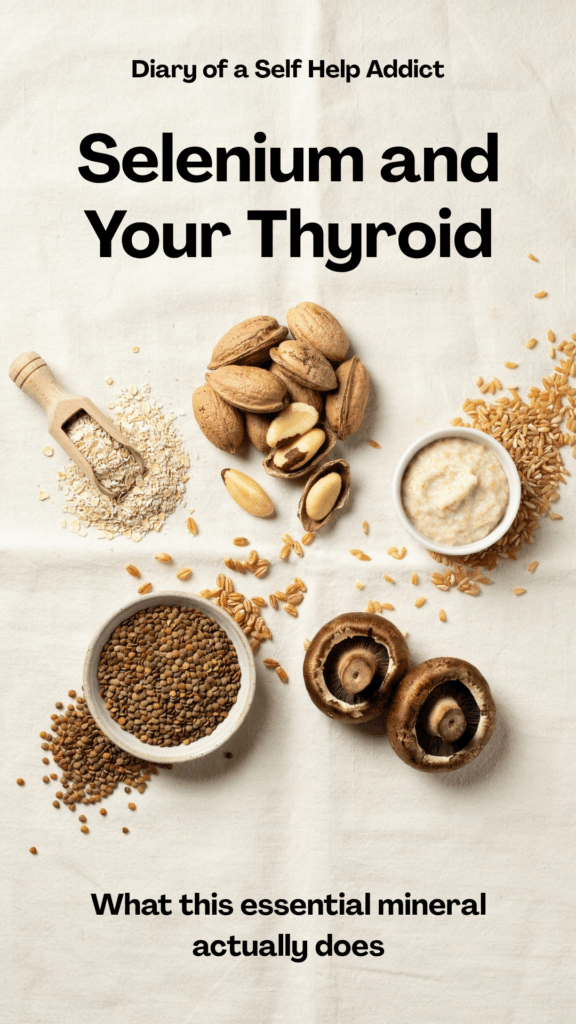
Selenium and Your Thyroid
Selenium is often connected with thyroid health, and for good reason: the thyroid contains more selenium per gram of tissue than any other organ.
Selenoproteins help convert thyroxine, or T4, into triiodothyronine, or T3—the active form of thyroid hormone. Other selenium-containing enzymes help protect thyroid tissue from the hydrogen peroxide naturally produced while thyroid hormones are being made.
That sounds impressive, but here is the part that sometimes gets lost online: needing adequate selenium is not the same as needing a high-dose selenium supplement. Research on selenium supplements for thyroid disease has been mixed, and the NIH says more research is needed.
Food first makes sense to me whenever it is practical, and one Brazil nut is about as easy as food gets.
How Much Selenium Do We Actually Need?
The Recommended Dietary Allowance, or RDA, for most adults is 55 micrograms per day. Pregnant women need 60 micrograms, and breastfeeding women need 70 micrograms.
The NIH lists Brazil nuts as containing approximately 68 to 91 micrograms of selenium per nut. Based on that estimate, one Brazil nut commonly provides more than a full day’s recommended amount for most adults.
That is why I eat one—not a handful.
There is an important little asterisk here: Brazil nuts are a natural food, not a precisely measured supplement. Their selenium content can vary significantly depending on where they were grown and how much selenium was present in the soil. Nuts from one region, harvest, or package may contain much more or less than nuts from another.
So we cannot say that every Brazil nut contains the same dose. What we can say is that Brazil nuts are exceptionally rich in selenium, and one nut will commonly cover the daily recommendation.
Why Brazil Nuts Contain So Much Selenium
Selenium is naturally present in soil. Plants absorb it through their roots, so the amount in plant foods depends partly on the soil where they were grown.
Brazil nut trees grow in the Amazon rainforest and develop incredibly deep, extensive root systems. They are especially good at taking up selenium from the soil and storing it in their nuts.
This is also why selenium levels can vary so much from one Brazil nut to another. Different areas of the Amazon have different amounts of selenium in the soil. Research has found large regional variations in Brazil nut selenium concentration.
That natural variability is another good reason to keep the portion modest.
Why I Eat Just One Brazil Nut a Day
I love finding small, realistic habits I can actually keep.
Eating one Brazil nut requires no preparation. I do not have to remember it later. I do not have to add it to a recipe. I keep the bag where I can see it, eat one with my forkful of sauerkraut, and then make my coffee.
It has become one of those automatic morning habits—like turning on the coffee maker or opening the blinds.
And because I eat a mostly whole-food, plant-based diet, I appreciate having a simple food source of a nutrient whose levels in plant foods can be unpredictable. Foods such as whole grains, beans, lentils, mushrooms, and seeds can contain selenium, but the amount varies with the soil. Brazil nuts are unusually concentrated.
I don’t eat one because I believe it will cure, prevent, or magically fix anything. I eat them because selenium is essential, Brazil nuts are a concentrated food source, and this is an easy habit that works for me.
Simple can be powerful… not because it is flashy, but because it is repeatable.
Can You Eat Too Many Brazil Nuts?
Yes. This is the section I really do not want anyone to skip.
Brazil nuts may look like the kind of food you should eat by the handful, but their selenium content makes them different from most other nuts.
One ounce of Brazil nuts—approximately six to eight nuts—contains an average of 544 micrograms of selenium, according to USDA data cited by the NIH. That is almost ten times the adult Daily Value and higher than the U.S. tolerable upper intake level of 400 micrograms per day.
The upper limit is not a goal. It is the highest average daily intake considered unlikely to cause adverse effects for most people. Regularly getting too much selenium can cause a condition called selenosis.
Possible symptoms of excessive selenium intake include:
- A garlic-like odor on the breath
- A metallic taste
- Nausea or diarrhea
- Fatigue or irritability
- Skin rash
- Brittle nails or nail loss
- Hair loss
- Nervous system problems
This is the perfect example of why “natural” does not automatically mean unlimited. We need selenium, but we do not need as much as possible.
For me, one Brazil nut is plenty. I don’t take a separate selenium supplement, and I check the labels on any multivitamins or supplements I use so I don’t unknowingly stack several selenium sources.
If you take a selenium-containing supplement, have a medical condition that affects your nutritional needs, are receiving kidney dialysis or cancer treatment, are pregnant, or have been told to modify your selenium intake, talk with your healthcare provider before making Brazil nuts a daily habit.
And, of course, Brazil nuts are tree nuts. Anyone with a tree-nut allergy should avoid them and discuss safe selenium sources with a qualified healthcare professional.

Does Selenium Prevent Cancer, Heart Disease, or Thyroid Disease?
You may see some very big health claims attached to selenium online. It is important to separate what selenium does in the body from what extra selenium has been proven to do.
Yes, selenium supports antioxidant defense, thyroid hormone metabolism, DNA synthesis, reproduction, and immune function.
No, that does not mean taking high doses has been proven to prevent cancer, heart disease, cognitive decline, or thyroid disease.
Large clinical trials have not shown that selenium supplements prevent cancer or cardiovascular disease in people who already get enough. Research into thyroid conditions has also produced mixed results.
The goal is adequacy, not excess.
That may not make as exciting a headline, but it is a much more honest way to think about nutrition.
What If You Do Not Like Brazil Nuts?
You do not need to eat Brazil nuts to get selenium.
Other foods contain it too. For those of us eating mostly or entirely plant-based, sources can include:
- Whole grains and whole-wheat bread
- Oatmeal
- Brown rice
- Beans and lentils
- Portobello mushrooms
The amount in plant foods varies because of differences in soil. People who eat animal products may also get selenium from seafood, meat, poultry, eggs, and dairy.
Most people in the United States already consume adequate selenium, and true selenium deficiency is considered rare here. So this is not a nutrient everyone needs to panic about or supplement automatically.
If you are concerned about your selenium intake (especially if you follow a restricted diet), the best next step is to discuss your diet and any supplements with your healthcare provider or a registered dietitian.
How I Make This Habit Easy
There is really no recipe required, but a few simple tricks help me stay consistent:
- I keep the Brazil nuts visible. If they disappear into the back of the pantry, I will forget about them.
- I connect the nut to something I already do. My one Brazil nut and forkful of sauerkraut come before my coffee, so coffee is the cue.
- I portion out one—not a handful. I take a single nut from the bag and put the bag away.
- I store them properly. Because nuts contain natural oils that can become rancid, I keep mine in an airtight container in the refrigerator or freezer, especially if I buy a larger bag.
- I check my supplements. If a multivitamin already contains selenium, I factor that in rather than assuming more is better.
It may be one of the least glamorous parts of my morning routine, but I love how easy it is.
The Bottom Line
Selenium is a mineral we need in tiny amounts for some very important jobs, including thyroid hormone metabolism, DNA synthesis, reproduction, antioxidant protection, and normal immune function.
Brazil nuts are one of nature’s most concentrated sources. Since one nut commonly contains about 68 to 91 micrograms of selenium, and most adults need 55 micrograms a day, one will usually provide at least a full day’s recommended amount.
But because selenium levels vary and too much can be harmful, this is one food where I do not believe a bigger serving is better. My habit is one Brazil nut a day, not a handful, and no additional selenium supplement unless a healthcare professional recommends it.
One nut. One forkful of sauerkraut. Then coffee.
It is simple, a little quirky, and very me.
Do you eat Brazil nuts? And do you have a tiny morning habit that is so easy you never forget it? Tell me in the comments—I would love to hear it.
Pin it for later
Disclaimer
This post is for informational and educational purposes only and reflects my personal routine. It is not medical advice and is not intended to diagnose, treat, cure, or prevent any disease. Nutritional needs vary. Always consult your physician, registered dietitian, or another qualified healthcare professional before changing your diet or supplements, especially if you are pregnant or breastfeeding, have a medical condition or food allergy, take medication, or are undergoing medical treatment. Also, as an Amazon Associate, I earn a small commission if you purchase through my links, at no extra cost to you. Thank you!
Leave a Reply