
I have a confession to make. For years… I didn’t wear sunscreen.
I know, I know. As a registered nurse who spends so much time talking about skincare and healthy aging, I can practically hear some of you gasping!
Of course, I wore it when I was spending the day at the beach or out on the water. But on an average day? Honestly… I skipped it.
Part of my hesitation was that I never loved the idea of applying sunscreen every single morning when I wasn’t planning to spend much time outdoors. Back then, I questioned whether it was really necessary for my lifestyle, and I wasn’t thrilled with how many formulas felt on my skin.
Then about three or four years ago, I really dove into my skincare journey.
I learned more about how ultraviolet (UV) rays contribute to premature aging, sun spots, collagen breakdown, and skin cancer. Daily sun protection became a habit, and I made it a priority to wear sunscreen on my face every single day even if I was mostly indoors.
Ironically, just as I finally became consistent with sunscreen… My skin decided it didn’t like it anymore.
Now, instead of protecting my skin, many sunscreens leave my face burning, itching, or covered in tiny red bumps. The sensitivity seems to be getting worse, not better.
So naturally, I started asking questions.
- Is this perimenopause?
- A damaged skin barrier?
- A new allergy?
- Hidden ingredients?
- Or is something else going on entirely?
If you’ve suddenly found yourself reacting to products you’ve used for years, you’re definitely not alone. Let’s explore some of the possible reasons and the changes I’m making in hopes of calming my skin down.
Can You Suddenly Become Allergic to Sunscreen?
Absolutely.
One of the biggest misconceptions about allergies is that they happen the very first time you use a product.
In reality, that’s often not how allergic contact dermatitis works.
Our immune system can become sensitized over time. After months or even years of repeated exposure to the same ingredient, your body may eventually recognize it as something it no longer tolerates.
That means a sunscreen you’ve happily used for years could suddenly begin causing redness, itching, burning, or a rash.
While it’s frustrating, it’s actually not uncommon.
Could Perimenopause Be Making It Worse?
It certainly might be contributing.
It seems like every strange symptom women develop in their 40s and 50s gets blamed on perimenopause.
Sometimes that’s true. Sometimes we simply don’t have all the answers.
What we do know is that declining estrogen affects the skin in several important ways. As estrogen levels fluctuate, your skin often becomes:
- Thinner
- Drier
- Less resilient
- More easily irritated
- Slower to heal
When your skin barrier becomes compromised, products you’ve tolerated for years may suddenly sting or burn.
Is perimenopause directly causing sunscreen allergies? Probably not. But it may be creating the perfect environment for irritation or sensitivities to become much more noticeable.
Related Read: WHY PHOTOZYME IS ONE OF MY “DESERTED ISLAND” SKINCARE MUST-HAVES (ESPECIALLY IF YOU’RE OVER 50)
Sensitive Skin Mineral Sunscreen Comparison
If you’re just looking for a quick recommendation, here’s a comparison of the mineral sunscreens I’ve used or am currently testing. I’ll explain why I chose these further down in the article.
This post may contain affiliate links. If you purchase through these links, I may earn a small commission at no additional cost to you. I only recommend products I personally use, trust, or am genuinely interested in trying. Read my privacy policy and disclosure here.
| Sunscreen | SPF | 100% Mineral? | Fragrance-Free | Best For | My Thoughts |
|---|---|---|---|---|---|
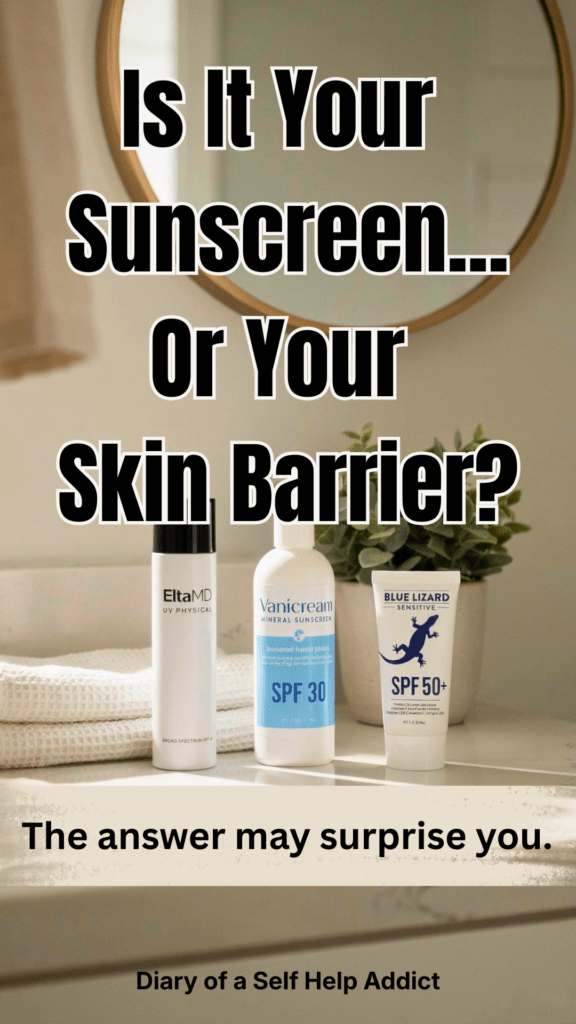
| EltaMD UV Physical SPF 41 | 41 | ✅ Yes | ✅ Yes | Sensitive, redness-prone skin | The only sunscreen my face is currently tolerating. Lightweight with a slight tint that helps even skin tone. |
| Vanicream Mineral Sunscreen SPF 30 | 30 | ✅ Yes | ✅ Yes | Extremely sensitive or allergy-prone skin | Next on my list to try. Dermatologists frequently recommend it because it’s free of common irritants and includes ceramides to support the skin barrier. |
| Blue Lizard Sensitive Mineral SPF 50+ | 50+ | ✅ Yes | ✅ Yes | Outdoor activities and highly reactive skin | Another dermatologist favorite with a simple formula and soothing aloe vera. Looking forward to testing it. |
| EltaMD UV Clear SPF 46 | 46 | ❌ Hybrid Formula | ✅ Yes | Acne-prone and rosacea-prone skin | I used to love this sunscreen, but my skin has become too sensitive for it. Since it contains both mineral and chemical UV filters, it no longer works well for my reactive skin. |
Before You Buy…
Remember that everyone’s skin is different. What irritates one person may be perfectly tolerated by another. If your skin has suddenly become reactive, look beyond the front label and read the entire ingredient list, including the inactive ingredients.
The Strange Part… I Was Already Using Mineral Sunscreen
Here’s what confused me. I’d already switched to mineral sunscreen years ago because it’s generally considered gentler for sensitive skin.
So why was my face still reacting? That’s when I started reading ingredient labels much more carefully. And I discovered something I hadn’t paid much attention to before.
Some “Mineral” Sunscreens Aren’t As Chemical-Free As They Appear
Many products marketed as mineral sunscreens contain additional inactive ingredients that improve texture, spreadability, or SPF performance.
One ingredient kept appearing over and over again: Butyloctyl Salicylate.
I also learned to watch for:
- Butyloctyl Salicylate
- Tridecyl Salicylate
- Ethylhexyl Salicylate
These ingredients aren’t active sunscreen filters, but they are related to salicylates and are sometimes used to improve the feel and performance of sunscreen formulas. For many people, they aren’t a problem. But for those with highly reactive skin, they may contribute to irritation.
Related Read: 4 TIPS TO BOOST YOUR SKIN’S NATURAL DNA REPAIR CAPABILITIES
Check Your Current Sunscreen
Here’s something easy you can do today. Flip your sunscreen bottle over. Don’t just read the active ingredients. Look at the inactive ingredients too.
If you see:
- Butyloctyl Salicylate
- Tridecyl Salicylate
- Ethylhexyl Salicylate
…your sunscreen may contain ingredients that some people with sensitive skin choose to avoid.
Side note: I’d also look for fragrance, which is one of the most common causes of allergic contact dermatitis. I’m in the process of making my home fragrance-free. Slowly switching out house-cleaning and personal care products for fragrance-free versions. Fragrances contain phthalates (used to make scents last longer) and other synthetic chemicals, which are known to interfere with the body’s natural hormone (endocrine) system.
Even My Favorite Sunscreen Started Irritating My Skin
For years I loved EltaMD. If you’ve followed me for a while, you’ve probably heard me recommend it.
Recently, though, even some EltaMD formulas began bothering my skin. That’s when I learned something important. Not every EltaMD sunscreen is the same.
For example, EltaMD UV Clear is a hybrid sunscreen that combines mineral and chemical UV filters. It’s a fantastic product for many people, but my skin no longer seems to tolerate it.
The one I’m currently doing well with is EltaMD UV Physical SPF 41, which uses mineral UV filters and has a simpler ingredient profile. It has become my “safe” sunscreen, for now.
Why Mineral Sunscreens Are Often Recommended for Sensitive Skin
If you have sensitive skin, eczema, rosacea, or frequent facial irritation, dermatologists often recommend mineral sunscreens first. Here’s why.
They Work Differently
Mineral sunscreens use zinc oxide and/or titanium dioxide to protect your skin from ultraviolet radiation.
Unlike traditional chemical UV filters, which penetrate the skin and trigger chemical reactions, these mineral ingredients primarily remain on the skin’s surface (like a barrier), where they help reflect, scatter, and absorb UV rays before they can damage the skin.
Many people with reactive skin simply find them more comfortable to wear.
Zinc Oxide Helps Calm Irritated Skin
Zinc oxide isn’t just a sunscreen ingredient. It’s also found in diaper rash creams, barrier creams, and other products designed to calm irritated skin. That makes it especially appealing if your skin is already inflamed.
They Start Working Right Away
Another nice bonus… Mineral sunscreens begin protecting as soon as you’ve applied an even layer, while many chemical sunscreens typically need to be applied about 15 minutes before sun exposure.
Related Read: RETINOLS, RETINOIDS, AND TRETINOIN: WHAT’S THE DIFFERENCE AND HOW I FINALLY FOUND MY HOLY GRAIL PRODUCT
Do Chemical Sunscreens Work Better?
You may have heard that chemical sunscreens provide better protection than mineral sunscreens.
In reality, both mineral and chemical sunscreens can provide excellent protection when they’re broad-spectrum (protects against UVA & UVB rays), and applied correctly. The biggest differences are how they work and how well your skin tolerates them.
Because my skin has become increasingly reactive, I’m personally focusing on mineral formulas with simpler ingredient lists. They seem to agree with my skin much better than hybrid or chemical formulas.
The SPF Myth vs Fact
One of the biggest sunscreen myths is that the higher the SPF number, the dramatically better the protection. That’s not exactly how SPF works. SPF measures how well a sunscreen protects against UVB rays, the rays primarily responsible for sunburn.
Here’s what the numbers actually mean:
| SPF 15 | 93% of UVB rays |
| SPF 30 | 97% of UVB rays |
| SPF 50 | 98% of UVB rays |
| SPF 100 | 99% of UVB rays |
Notice something?
Going from SPF 30 to SPF 50 doesn’t give you dramatically more protection; it increases UVB protection by only about 1 percentage point (roughly a 2% reduction in the UV rays that get through compared with SPF 30).
That’s why dermatologists often say that how much sunscreen you apply and how often you reapply it are far more important than chasing the highest SPF number.
If you’re only applying half the recommended amount of SPF 100, you may actually be getting less protection than someone who generously applies SPF 30.
For me, finding a sunscreen that my skin actually tolerates is much more important than buying the highest SPF on the shelf. A sunscreen you enjoy wearing every day is far better than one that sits unused in the bathroom cabinet.
The Two Sunscreens I’m Trying Next (Because I like options)
Since my face has become so reactive, I started looking for formulas with fewer potential irritants. These are the two I’m excited to test.
Vanicream Mineral Sunscreen SPF 30
This one is recommended by dermatologists over and over for sensitive skin.
It is:
- Fragrance-free
- Dye-free
- Paraben-free
- Free of formaldehyde-releasing preservatives
- Formulated with ceramides to help support the skin barrier
Everything about it sounds promising.
Blue Lizard Sensitive Mineral Sunscreen SPF 50+
This is another sunscreen that consistently appears on dermatologist recommendation lists.
I like that it offers:
- A simple ingredient list
- No added fragrance
- Mineral UV filters
- Aloe vera to help soothe the skin
Sometimes simple really is best.
I’ll be testing both over the next several weeks and will report back with an update.
Don’t Forget About Your Skin Barrier
Sometimes the sunscreen isn’t actually the problem. The skin barrier is.
If your barrier has been weakened by over-exfoliation, retinoids, vitamin C, harsh cleansers, microneedling, lasers, or simply aging, almost anything can start to sting.
Supporting your skin barrier may be just as important as changing your sunscreen.
Look for moisturizers that contain:
- Ceramides
- Glycerin
- Squalane
- Colloidal oatmeal
- Hyaluronic acid
Here are a few to consider trying based on amazing reviews and their ingredient lists:
Keeping your skincare routine simple for a few weeks can often make a huge difference.
Related Read: THE ULTIMATE GUIDE TO EXFOLIATING ACIDS IN SKINCARE
When Should You See a Dermatologist?
If your rash keeps returning despite changing products, or if you’re experiencing severe itching, swelling, blistering, or hives, it may be time to see a dermatologist.
Patch testing can often identify specific ingredients responsible for allergic contact dermatitis and take much of the guesswork out of choosing skincare products.
Kelly’s Biggest Takeaway
I never thought sunscreen would become one of the hardest products for me to wear. For years, I didn’t wear it every day. Then I learned why daily sun protection matters and made it part of my routine.
Now I’m learning something else:
- Finding the right sunscreen isn’t always as simple as choosing one labeled “mineral.”
- Our skin changes as we age.
- Hormones change.
- Our skin barrier changes.
- Sometimes our immune system changes too.
- What worked beautifully five years ago may not work today.
I’m hopeful that simplifying my skincare routine, paying closer attention to ingredient lists, and trying formulas specifically designed for highly sensitive skin will finally help me wear sunscreen comfortably every single day.
If you’ve been dealing with the same frustrating facial irritation, I’d love to hear from you.
Have you suddenly become sensitive to sunscreen?
Did you find a product that finally worked?
Leave a comment below. Your experience might help someone else who’s searching for answers, too.
Pin it for later
This is a lot of great info! I, too once thought that you couldn’t get allergic to a product over time. Slowly learning more and more!
I’m not actually allergic, but I did notice a stronger reaction to all SPFs. This was useful information, I see I’ll need to inform myself better! Thank you!