

Magnesium is one of the most important minerals in the human body, yet it’s also one of the most misunderstood when it comes to supplements.
If you’ve ever looked at magnesium supplements online or in the store, you’ve probably noticed something confusing…
There isn’t just one magnesium supplement.
There are actually many different types of magnesium, including glycinate, citrate, malate, threonate, taurate, chloride, orotate, and more.
Each type is combined with a different compound, which changes how the body absorbs it and what systems it may support.
Some forms are better for sleep and relaxation.
Some help digestion.
Others support brain health, muscles, or energy production.
Understanding the differences can help you choose the magnesium supplement that works best for your body.
Medical Disclaimer:
This content is for informational purposes only and is not intended to provide medical advice. Always consult with your healthcare provider before starting any supplement, especially if you are pregnant, nursing, taking prescription medications, or have a medical condition. Individual results may vary.
Quick Guide: Types of Magnesium
(Click to jump to each section below)
There are many forms of magnesium supplements, but the most common types include:
- Magnesium Glycinate → Jump to Section
- Magnesium Bisglycinate → Jump to Section
- Magnesium Citrate → Jump to Section
- Magnesium L-Threonate → Jump to Section
- Magnesium Malate → Jump to Section
- Magnesium Taurate → Jump to Section
- Magnesium Chloride → Jump to Section
- Magnesium Orotate → Jump to Section
- Magnesium Oxide → Jump to Section
- Magnesium Sulfate → Jump to Section
- Magnesium L-Aspartate → Jump to Section
Each form is paired with a different compound that affects how it’s absorbed and what benefits it may provide.
Below, we’ll break down the differences and help you choose the magnesium supplement that best fits your needs.
Why Magnesium Is So Important
Magnesium plays a role in over 300 biochemical processes in the body.
It helps support:
• muscle function
• nerve signaling
• sleep regulation
• energy production
• blood sugar balance
• heart rhythm
• bone health
• mood and stress response
Despite its importance, many people don’t get enough magnesium.
Modern farming practices have depleted soil magnesium levels, so our food often contains less magnesium than it did in the past. On top of that, stress, caffeine, alcohol, and certain medications can all deplete magnesium levels in the body.
Some possible signs of low magnesium include:
• muscle cramps
• fatigue
• poor sleep
• headaches or migraines
• anxiety or irritability
• constipation
• irregular heartbeat
Because magnesium supports so many systems in the body, choosing the right form can make a difference.
Related Read: HYDRATION ISN’T JUST WATER: THE IMPORTANCE OF ELECTROLYTES + A CLEAN DIY ELECTROLYTE MIX WITHOUT THE JUNK

Quick Guide to the Different Types of Magnesium
Here’s a simple comparison of the most common forms.
| Magnesium Glycinate | Sleep, relaxation, stress, headaches/migraines (HA) | Highly absorbable and gentle. Most popular form |
| Magnesium Bisglycinate | Sleep, anxiety, muscle relaxation | Very bioavailable chelated form |
| Magnesium Citrate | Constipation, digestion, HA | Well absorbed but may have a mild laxative effect at higher doses. |
| Magnesium L-Threonate | Brain health, memory, HA | Crosses the blood-brain barrier |
| Magnesium Malate | Energy, fatigue, muscle performance | Often recommended for people with low energy or muscle discomfort. |
| Magnesium Taurate | Heart health, blood pressure support, nervous system balance | Combines magnesium with taurine, which may support cardiovascular health. |
| Magnesium Chloride | Muscle cramps, electrolyte balance | Often used in sprays or oils topically |
| Magnesium Orotate | Heart health, exercise performance, cellular energy | May support cardiovascular function and athletic performance. |
| Magnesium Oxide | Occasional constipation | Poor absorption, but least expensive, so often recommended by providers |
| Magnesium Sulfate | Muscle relaxation, bath therapy, and headaches | Commonly found in Epsom salts and used in baths for muscle and stress relief. |
| Magnesium L-Aspartate | Energy production, fatigue, cellular metabolism | Highly bioavailable and often used in energy-support formulas. |
As an Amazon Associate, some of the links in this post are affiliate links, which means I may earn a small commission at no additional cost to you if you make a purchase. I only recommend products I personally use or genuinely trust. Your support helps me keep creating helpful content!
Magnesium Glycinate
Magnesium glycinate is magnesium bound to the amino acid glycine.
This form is widely considered one of the most absorbable and gentle types of magnesium.
Glycine itself has calming properties, which makes this form especially helpful for relaxation and sleep.
Benefits
- supports relaxation
- may improve sleep quality
- helps calm the nervous system
- gentle on the stomach
- less likely to cause digestive upset
- relieves headaches
Best For
- sleep support
- stress management
- muscle relaxation
- daily magnesium supplementation
This is actually my personal favorite type of magnesium because it absorbs well and tends to be very easy on digestion.
Magnesium Bisglycinate
Magnesium bisglycinate is a form of magnesium where the mineral is bound to two glycine molecules.
Because of this structure, it is considered a chelated form of magnesium, meaning the body can absorb it very efficiently.
Many high-quality magnesium supplements use this form because it is both highly bioavailable and gentle on the stomach.
Benefits
• excellent absorption
• calming effect on the nervous system
• gentle on digestion
• supports sleep and relaxation
Best For
• sleep support
• anxiety and stress
• people with sensitive stomachs
Magnesium Citrate
Magnesium citrate combines magnesium with citric acid.
This is one of the most common magnesium supplements and is known for its digestive effects.
Benefits
- relatively well absorbed
- helps relieve occasional constipation
- supports muscle and nerve function
- headace relief
Best For
- digestive support
- occasional constipation
Because it draws water into the intestines, it can sometimes cause loose stools if taken in higher amounts.
Magnesium L-Threonate
Magnesium L-threonate is a newer form of magnesium that has been studied for its potential effects on brain health.
Researchers at the Massachusetts Institute of Technology developed this form while studying the effects of magnesium on memory and learning.
Magnesium L-threonate appears to cross the blood-brain barrier more efficiently than many other forms.
Benefits
- supports cognitive function
- may help memory and learning
- supports brain magnesium levels
- may help mental clarity
- headache and migraine relief
Best For
- brain health
- focus and memory
- cognitive support
Magnesium Malate
Magnesium malate combines magnesium with malic acid, which is involved in cellular energy production.
Benefits
- supports energy production
- may help reduce muscle soreness
- supports exercise recovery
Best For
- fatigue
- muscle pain
- energy support
Magnesium Taurate
Magnesium taurate combines magnesium with taurine, an amino acid associated with cardiovascular health.
Benefits
- supports heart health
- may help maintain healthy blood pressure
- supports nervous system balance
Best For
- cardiovascular support
- heart rhythm balance
Magnesium Chloride
Magnesium chloride is a highly absorbable form of magnesium, often used in topical products such as sprays and oils.
Benefits
- supports electrolyte balance
- helps relax muscles
- often used for athletic recovery
Best For
- muscle cramps
- muscle soreness
- topical magnesium use
Magnesium Orotate
Magnesium orotate is magnesium combined with orotic acid, a compound involved in cellular energy production.
Benefits
- supports heart health
- may improve exercise tolerance
- supports cellular energy
Best For
- cardiovascular support
- exercise recovery
Magnesium Oxide
Magnesium oxide is one of the most common magnesium supplements available, but it is also one of the least absorbable forms.
Because the body doesn’t absorb it well, magnesium oxide often acts more like a laxative than a true magnesium supplement. It’s most commonly recommended by healthcare providers because it’s the least expensive form.
Why I Don’t Recommend Magnesium Oxide
In many cases, magnesium oxide simply pulls water into the intestines, causing diarrhea rather than effectively increasing magnesium levels in the body.
For that reason, I usually recommend choosing more bioavailable forms of magnesium, such as glycinate, bisglycinate, or citrate.
Magnesium Sulfate
Magnesium sulfate is a compound of magnesium and sulfate, commonly found in Epsom salts. It’s often used topically in baths, but can also be taken orally in specific doses.
Benefits
• supports muscle relaxation
• promotes detoxification
• may help soothe aches and pains
• can improve skin health when used topically
Best For
• muscle tension and cramps
• stress relief and relaxation
• bath or topical magnesium therapy
Magnesium L-Aspartate
Magnesium L-aspartate is magnesium bound to aspartic acid, an amino acid involved in energy production and cellular function.
Benefits
• supports energy production
• may reduce fatigue
• aids in cellular function and metabolism
• highly bioavailable
Best For
• fatigue and low energy
• cellular health and recovery
• overall metabolic support
Related Read: THE POWER OF MAGNESIUM: YOUR GUIDE TO A HEALTHIER YOU.

How Much Magnesium Should You Take?
The recommendationed daily allowance (RDA) for magnesium intake is approximately:
Women: 310–320 mg per day
Men: 400–420 mg per day
However, individual needs can vary depending on stress levels, activity level, diet quality, and overall health.
It’s usually best to start with a moderate dose and adjust as needed based on how your body responds.
Personally, I typically take around 400 mg per day, but sometimes increase my intake to closer to 800–or even 1200 mg per day depending on how I’m feeling.
I usually prefer to take magnesium in the evening, about an hour before bed, since magnesium can help support relaxation and sleep quality.
That said, magnesium won’t knock you out like a sleep medication. Instead, it helps calm the nervous system and supports the body’s natural sleep processes.
Because of this, magnesium can absolutely be taken during the day as well, especially if you’re using it for muscle support, stress, or general magnesium intake.
My Personal Magnesium Routine
Believe it or not, even though I talk about supplements a lot, I don’t actually take many regularly.
The two I rarely miss are magnesium (year-round) and vitamin D3/K2 (during the winter months).
Magnesium is one supplement I take very consistently because so many people are depleted in it. Magnesium is involved directly or indirectly in hundreds of processes in the body — over 300 known functions and potentially more than 800 biochemical reactions depending on how they’re measured.
Unfortunately, magnesium deficiency is extremely common. Some estimates suggest over 80% of people may not be getting enough magnesium.
Certain things can increase your risk of low magnesium levels, including:
• chronic stress
• taking prescription medications
• low magnesium intake from food
• illness or chronic disease
• poor soil quality in modern agriculture
• vitamin D supplementation (which increases magnesium demand)
If you’re under a lot of stress, taking medications, supplementing with vitamin D, or simply not eating a consistently balanced diet, there’s a good chance your body may benefit from more magnesium.
That’s one of the main reasons magnesium has become a staple supplement in my own routine.
After experimenting with various magnesium supplements over the years, magnesium glycinate remains my personal favorite.
It absorbs well, tends to be gentle on digestion, and works great for relaxation and sleep support.
Recently, I’ve also been using Magnesium Breakthrough from BiOptimizers, and I’ve been really liking it.
This supplement contains seven different forms of magnesium, including:
• bisglycinate
• citrate
• malate
• taurate
• chelate
• orotate
• sucrosomial magnesium
The idea is that each form supports different systems in the body, from brain health to muscle recovery to relaxation.
I like that it offers a broad-spectrum approach to magnesium, but if I’m buying just one magnesium supplement, I usually still reach for magnesium glycinate or bisglycinate.

Magnesium From Food
While supplements can be helpful, magnesium is also found in many whole foods.
Magnesium-rich foods include:
• leafy greens like spinach and kale (check out my smoothie recipe below)
• pumpkin seeds
• almonds and cashews
• black beans
• avocado
• dark chocolate
• whole grains
Eating a variety of whole foods is still one of the best ways to support healthy magnesium levels.
Related Read: BOOST YOUR HEALTH: HOW TO GET MORE GREENS INTO YOUR DIET
Frequently Asked Questions About Magnesium
What is the best type of magnesium?
Magnesium glycinate and magnesium bisglycinate are often considered some of the best overall forms because they are highly absorbable and gentle on digestion.
Which magnesium helps with sleep?
Magnesium glycinate and magnesium bisglycinate are commonly used for sleep because glycine helps support relaxation.
Which magnesium helps with constipation?
Magnesium citrate is commonly used for occasional constipation.
Why is magnesium oxide not recommended?
Magnesium oxide is poorly absorbed and often acts primarily as a laxative rather than increasing magnesium levels in the body.
Magnesium Types Cheat Sheet
If you’re just looking for a quick overview, here’s a simple cheat sheet.
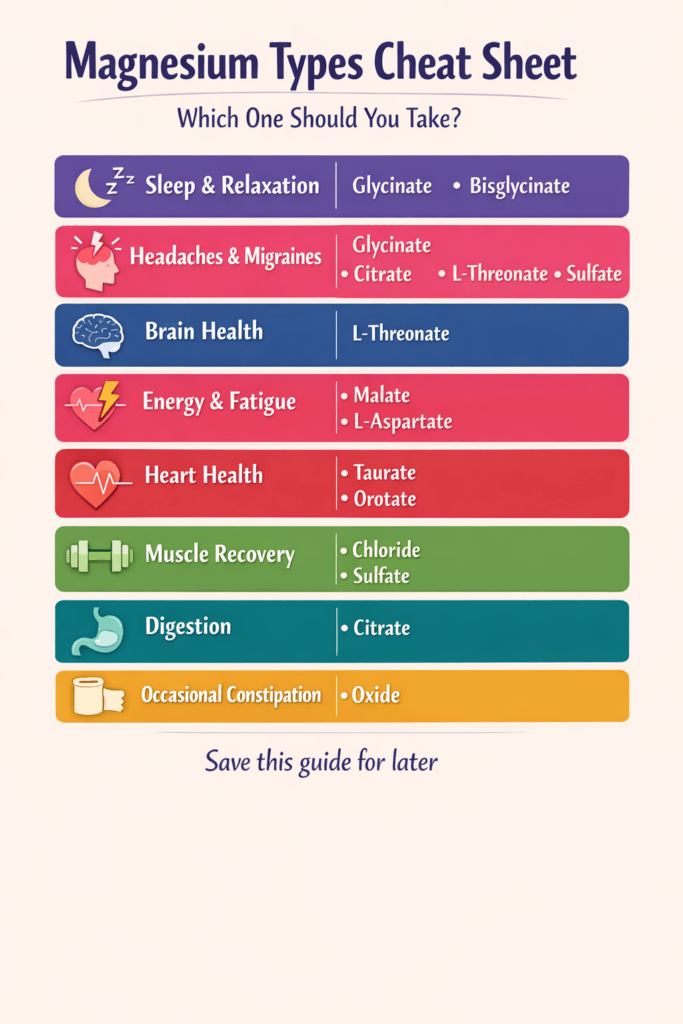
Save this guide to Pinterest so you can easily remember which type of magnesium supports sleep, brain health, digestion, and energy.
Kelly’s Thoughts: Choosing the Right Magnesium
Magnesium may not always get the same attention as some other nutrients, but it plays an incredibly important role in overall health.
From supporting sleep and relaxation to helping with muscle function, energy production, brain health, and heart health, magnesium is involved in hundreds of processes that keep the body functioning properly.
Because there are several different forms of magnesium, the best choice often depends on your specific health goals.
Some people benefit most from magnesium glycinate for sleep and relaxation, while others may prefer magnesium malate for energy or magnesium L-threonate for brain support.
The key is understanding that not all magnesium supplements are the same, and choosing a form that works well for your body.
For me, magnesium glycinate is the one I return to again and again because it’s gentle, highly absorbable, and supportive of sleep and stress.
If you’ve been curious about magnesium or wondering which type might be right for you, I hope this guide helped simplify the options.
And if you found this helpful, save this guide to Pinterest so you can easily reference the different magnesium types later.
You never know when someone else might be standing in the supplement aisle, wondering:
“Wait… which magnesium am I supposed to take?”
Comment down below and let me know what your favorite magnesium supplement brand and type is so we can learn from each other.
And as always, before starting any new supplement, it’s wise to check with your healthcare provider, especially if you take medications or have underlying health conditions.
Pin it for later

Leave a Reply