
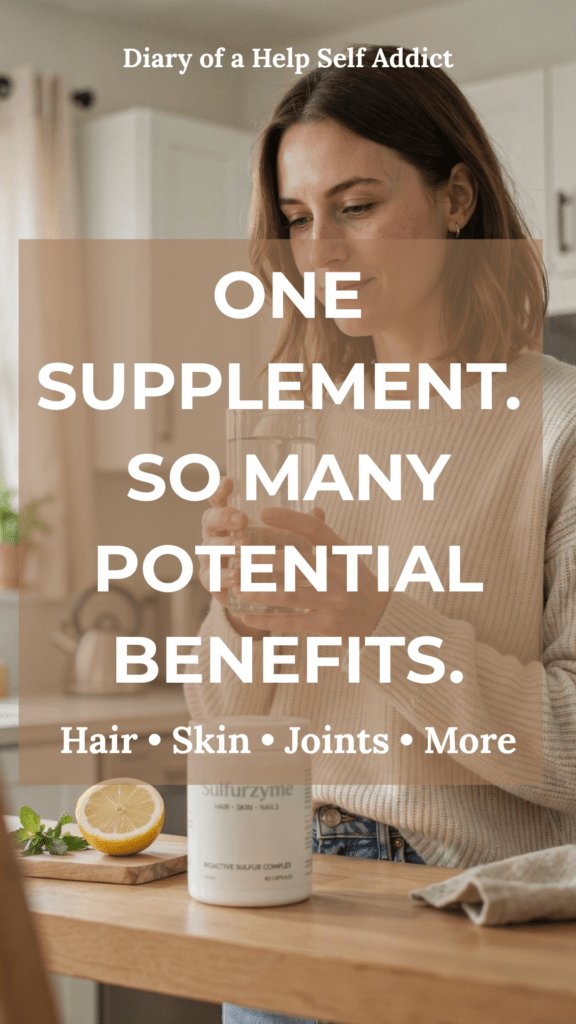
Could a sulfur supplement help support your hair, skin, joints, and overall wellness? Here’s why I started taking Young Living Sulfurzyme, and what I discovered along the way.
I’ll never forget how frustrating it was to lose my hair after having COVID.
Although thin, I’ve always had pretty healthy hair, so suddenly seeing so much of it coming out was upsetting. My hair felt thinner, my ponytail wasn’t what it used to be, and worse, I had a balding spot near the nape of my neck!
This happened around 2021/2022, and I started looking for ways to support my hair from the inside out.
That’s when I started taking Young Living’s Sulfurzyme.
And honestly? I was pleasantly surprised.
Over time, I felt like my hair started growing back and becoming thicker again. Was Sulfurzyme absolutely, scientifically proven to be the reason? No. I can’t say that.
But I know what I experienced.
And I’ve since recommended it to several friends who experienced hair loss or thinning for completely different reasons. They’ve told me they’ve had positive experiences with it, too.
That was enough to make me curious about what was actually in Sulfurzyme, what MSM does, and what the research says.
And there’s more to this supplement than I originally realized.
What Is Sulfurzyme?
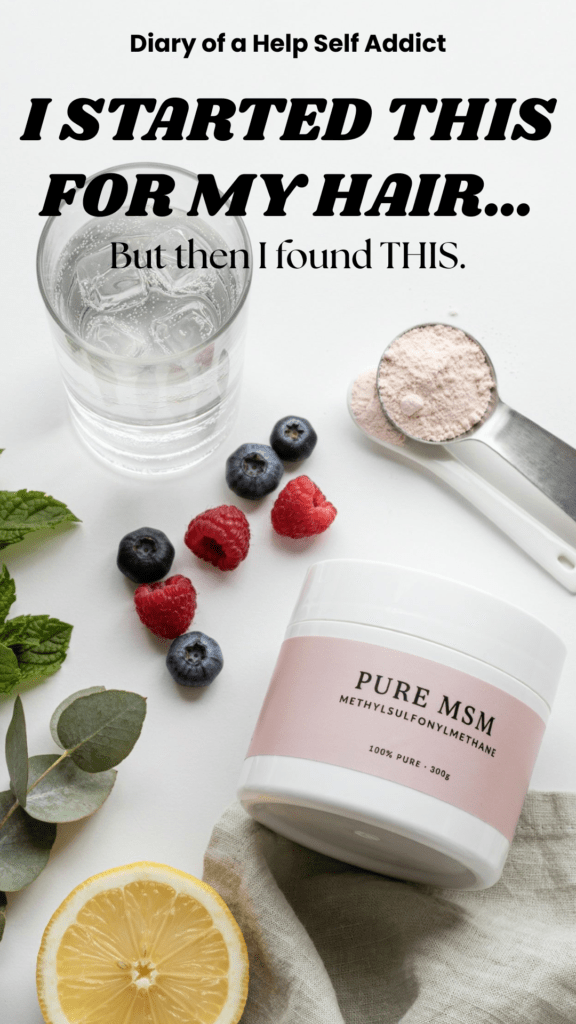
The main ingredient that caught my attention is MSM, or methylsulfonylmethane.
MSM is a sulfur-containing compound that occurs naturally in foods and in the body. Sulfur is involved in many of the body’s normal processes, including the structure of proteins.
Sulfur is particularly interesting when we’re talking about hair, skin, and nails, because these tissues contain keratin, a protein that includes sulfur-containing amino acids.
That doesn’t mean taking MSM automatically makes your hair grow.
But it gives us an interesting reason to investigate it.
Young Living’s Sulfurzyme products combine MSM with Ningxia wolfberry (goji berry) and are available in both capsule and powder forms.
And if you’ve been around me for any length of time, you probably know which one I’m choosing.
The powder!
I’m not a great pill taker, so I love being able to mix the powder into water. And honestly, I actually like the taste, which makes it much easier for me to take consistently.
Why Did I Start Taking It?
Hair loss.
That was my motivation.
After COVID, I experienced significant hair shedding. This type of shedding can occur after illness or other physical stress, and there are many reasons for hair loss.
I wasn’t looking at Sulfurzyme as a magic cure. I was simply looking for something that might provide nutritional support while my body recovered.
And after taking it consistently, I noticed my hair beginning to look and feel fuller again.
That’s why I kept taking it.
Then I started wondering:
What else could MSM be doing?
That’s where the research gets interesting.
Related Read: DMSO: THE PAIN-RELIEVER THAT SMELLS LIKE GARLIC
What Does the Research Say About MSM?
I’m always interested in the research behind something I’m taking, and I don’t want to tell you that something works simply because I personally like it.
So I dug into some of the human studies on MSM.
The research is still relatively limited, and some studies are small. But there are some pretty interesting findings involving exercise recovery, oxidative stress, inflammation, joint health, and skin.
MSM and Exercise Recovery
If you’re someone who exercises regularly, this one caught my attention.
One small study examined MSM supplementation in healthy men and found potential benefits for exercise recovery, including changes in markers of oxidative stress and muscle soreness.
It was a very small pilot study, so obviously we need larger research before drawing big conclusions.
But here’s how I think about it in real life:
If you work out and sometimes feel like your body takes longer to bounce back than it used to, MSM is an interesting supplement to know about.
It’s not a replacement for sleep, hydration, protein, good nutrition, or adequate recovery time. But it may be one more piece of the puzzle.
MSM and Oxidative Stress
Another study looked at what happened when healthy young men took MSM before doing a strenuous treadmill workout.
The researchers found that MSM reduced some markers of exercise-induced oxidative stress and increased total antioxidant capacity 24 hours after exercise.
The study was small (only 16 men), so again, we’re talking about an interesting finding rather than definitive proof.
But I like thinking about this in practical terms.
Exercise is good for us, but hard exercise also puts temporary stress on the body. Supporting the body’s normal response to that stress is one reason MSM interests me.
MSM and Inflammation
Inflammation has become one of those words we hear constantly.
But inflammation isn’t automatically bad. It’s a normal part of how our bodies respond to things like exercise and injury.
Researchers have examined whether MSM can influence certain inflammatory responses in the body following strenuous exercise.
One study found that MSM affected several inflammatory markers following exercise.
Again, this was not a huge study, and it doesn’t mean MSM “stops inflammation.”
I think a better way to look at it is that MSM may help support a healthy inflammatory response, which is very different from claiming that it treats an inflammatory disease.
And that’s the kind of distinction I want to make here.
I’m sharing what I find interesting, not making medical promises.
What About Joints?
This is probably one of the most interesting potential benefits of MSM for anyone getting older.
One randomized, double-blind study examined people with mild-to-moderate osteoarthritis and compared glucosamine, MSM, their combination, and placebo.
After 12 weeks, people taking MSM showed improvements in measures such as pain, swelling, and physical function compared with placebo. The combination of glucosamine and MSM performed even better in some measures.
Now, does that mean MSM cures arthritis?
No.
But if you’re someone who occasionally thinks, “Why do my knees feel older than the rest of me?” you can understand why researchers are interested in MSM for joint comfort.
For people who enjoy walking, strength training, Pilates, running, gardening, traveling, or simply want to keep moving comfortably, joint health becomes increasingly important.
And personally, I’d much rather think about supporting healthy movement now than wait until I’m struggling to move later.
MSM and Skin Health
This one really caught my attention because I’m also interested in skin health and aging well.
Researchers have studied oral MSM for its potential effects on skin appearance.
One small placebo-controlled study found improvements in skin firmness, tone, texture, and the appearance of wrinkles among people taking MSM.
A later study also examined different MSM doses and reported improvements in measures such as wrinkles, skin firmness, elasticity, and hydration.
These weren’t enormous studies, so I’m definitely not going to tell you that taking MSM is going to erase your wrinkles.
Wouldn’t that be nice, though?
But I do find it fascinating that researchers are seeing potential changes in the skin from something taken internally.
To me, that’s another reminder that what we put into our bodies can matter just as much as what we put on our bodies.
And Then There’s My Hair…
Which brings me right back to why I started taking Sulfurzyme in the first place.
My hair.
This is where I want to be especially honest.
I don’t have a clinical study showing that Sulfurzyme caused my hair to grow back after COVID.
The research I found on MSM is much more developed in areas like exercise recovery, oxidative stress, inflammation, joints, and skin than it is specifically for hair regrowth.
So I wouldn’t tell someone, “Take Sulfurzyme and your hair will grow back.”
That’s not something we know.
What I can tell you is what happened to me.
I started taking Sulfurzyme after experiencing significant hair shedding following COVID. Over time, my hair grew back and became thicker.
I’ve also recommended it to several friends who experienced hair loss for other reasons, and they’ve told me they noticed improvements.
Could those results have happened naturally?
Absolutely.
Hair goes through growth and shedding cycles, and there are many reasons someone may experience temporary hair loss.
But for me, Sulfurzyme became something I wanted to continue.
And that’s really the difference between sharing a personal experience and making a medical claim.
I’m sharing my experience, not promising that you’ll have the same one.
How I Take Sulfurzyme
Sulfurzyme comes in both capsule and powder forms.
I prefer the powder for one very simple reason:
I don’t like taking pills!
I mix the powder into water, and I actually enjoy the taste.
Young Living’s current U.S. directions for the powder recommend ½ teaspoon twice daily, mixed with juice or water, preferably one hour before or after meals.
As always, check the directions for the specific product you’re purchasing, as formulations and recommendations can change.
And please don’t assume that taking more will get you better results.
More isn’t always better when it comes to supplements.
Is Sulfurzyme Safe?
As with any supplement, “natural” doesn’t automatically mean “right for everyone.”
MSM has generally been well tolerated in the human studies I’ve reviewed, although some people may experience digestive upset or other side effects.
If you’re pregnant or breastfeeding, taking medication, have a medical condition, or simply aren’t sure whether MSM is appropriate for you, talk with your healthcare professional before adding it to your routine.
And if you’re experiencing significant or persistent hair loss, don’t just throw supplements at the problem.
Hair loss can have many causes, including nutritional deficiencies, hormonal changes, illness, medications, and other medical conditions.
Finding the cause of hair loss is important.
Related Read: CREATINE: A DEEP DIVE INTO ITS BENEFITS, RISKS, AND EMERGING ROLE IN WOMEN’S HEALTH
So…Would I Recommend Sulfurzyme?
For me?
Yes.
I originally started taking Sulfurzyme to support my hair after COVID.
I didn’t expect that I’d become interested in its potential benefits for joints, exercise recovery, oxidative stress, and skin, too.
And I love that I can take it as a powder in my water instead of trying to swallow another handful of pills.
But I think the biggest thing I’ve learned is this:
There is a difference between saying something helped you and saying something is scientifically proven to treat a condition.
My hair story is personal.
The research on MSM is promising in several areas, but more and larger studies are still needed.
And I’m perfectly comfortable saying both things.
Because I don’t need to call something a miracle to think it’s worth trying.
For me, Sulfurzyme has simply become one of those supplements that I enjoy having in my wellness routine, and it all started with wanting my hair back.
If you’re already using MSM or Sulfurzyme, I’d love to know about your experience. Did you start taking it for your hair, joints, skin, exercise recovery, or something completely different?
A Note From Kelly
This article reflects my personal experience and my review of available research. It is for educational and informational purposes only and is not medical advice. Dietary supplements are not intended to diagnose, treat, cure, or prevent disease.
If you are experiencing unexplained, sudden, patchy, or persistent hair loss, talk with a qualified healthcare professional or dermatologist to determine the underlying cause. Always follow the directions on your specific supplement label and speak with your healthcare professional before taking supplements if you are pregnant, breastfeeding, taking medications, or have a medical condition.
Research & Further Reading
- Kalman DS, et al. Influence of methylsulfonylmethane on markers of exercise recovery and performance in healthy men: a pilot study. Journal of the International Society of Sports Nutrition. 2012. Read the PubMed study
- Nakhostin-Roohi B, et al. Effect of single dose administration of methylsulfonylmethane on oxidative stress following acute exhaustive exercise. Iranian Journal of Pharmaceutical Research. 2013. Read the PubMed study
- Usha PR, Naidu MU. Randomized, double blind, parallel, placebo-controlled study of oral glucosamine, methylsulfonylmethane and their combination in osteoarthritis. Clinical Drug Investigation. Read the PubMed study
- van der Merwe M, Bloomer RJ. The Influence of Methylsulfonylmethane on Inflammation-Associated Cytokine Release before and following Strenuous Exercise. Read the PubMed study
- Anthonavage M, Benjamin R, Withee E. Effects of Oral Supplementation With Methylsulfonylmethane on Skin Health and Wrinkle Reduction. Read the ResearchGate study
Pin it for later

Leave a Reply